


Scientists Uncover Evidence That Molecule Released During Exercise, Also Available as a Supplement, Slows Cognitive Decline with Age
According to a new study, whether from exercise or supplementation, increased levels of β-hydroxybutyrate (a molecule primarily released from the liver during fasting or aerobic exercise) improve cognition in old mice.
Highlights
- Aerobic exercise (sustained physical activity using large muscle groups) elevated circulating β-hydroxybutyrate and improved cognition in old mice.
- Injecting old mice with β-hydroxybutyrate mimicked the cognitive improvements associated with exercise.
Aging is a critical factor in cognitive decline and neurodegeneration, and effective interventions to counteract age-related neurological dysfunction and decline remain, in large part, limited. Now, as published in the Journal of Sport and Health Science, Xiao and colleagues from Shanghai University of Sport in China unveil data showing that old mice that underwent aerobic exercise exhibited increased circulating β-hydroxybutyrate, a molecule primarily released by the liver, which the brain and muscles use as fuel. Not only that, but increased β-hydroxybutyrate from exercise was associated with improvements in cognition. Xiao and colleagues also injected old mice with a β-hydroxybutyrate supplement, which mimicked the beneficial cognitive effects associated with increased circulating β-hydroxybutyrate from aerobic exercise. These findings suggest that supplementing with β-hydroxybutyrate may be a means to enhance cognition and prevent age-related cognitive decline.
Background on β-Hydroxybutyrate
Β-hydroxybutyrate is the most abundant of naturally occurring compounds produced in the liver from lipids, known as ketone bodies, in the human body. This molecule is produced as an alternative fuel source for the brain and muscles under aerobic exercise or fasting conditions when circulating glucose is low. It is also under investigation for potential therapeutic benefits in age-related conditions like neurodegenerative diseases, heart failure, and liver disorders due to its possible anti-inflammatory and neuroprotective properties.
Exercise’s Age-Slowing Benefits
Aerobic exercise has been widely demonstrated to slow many aspects of age-related physiological damage and provide extensive health benefits. It has also been shown to enhance cognitive performance, alleviate mental conditions like depression and insomnia, and slow the progression of neurodegenerative diseases. Beyond its neurological effects, aerobic exercise also reprograms immune and metabolic pathways across multiple tissues to restore organismal physiological balance and protect against age-related diseases.
Recent research has demonstrated that exercise-induced signaling molecules, referred to as exerkines, are secreted from a number of tissues, like muscle, liver, and neurons. Exerkines subsequently influence molecular pathways to regulate metabolic, immune, cardiovascular, and neurological function, facilitating resilience and healthy aging. Therefore, exploring whether supplementing with exerkines, like β-hydroxybutyrate, can mimic exercise’s neuroprotective effects is critical to advance research on strategies to slow cognitive aging.
Because accumulating evidence suggests that β-hydroxybutyrate alleviates multiple age-related pathologies, including neurodegenerative diseases, Xiao and colleagues tested whether this exerkine helps explain, at the molecular level, how exercise confers neuroprotection and improved cognition. Their results showing that supplemental injections of β-hydroxybutyrate indeed mimic aerobic exercise’s cognition-enhancing effects in old mice also suggest that β-hydroxybutyrate supplementation may work to preserve cognition in humans with age.
Exercise and Supplementation Increase Circulating β-Hydroxybutyrate, Improving Cognition
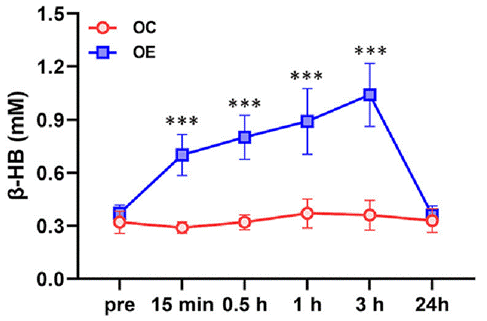
To confirm that aerobic exercise increases circulating β-hydroxybutyrate, Xiao and colleagues subjected old, 19-month-old mice (roughly equivalent to age 60 in humans) to a one-hour session of treadmill running. Following the hour of treadmill running, the researchers measured circulating β-hydroxybutyrate. They found that the exercise session more than doubled circulating levels of β-hydroxybutyrate three hours after the exercise, and that these levels tapered off to baseline at 24 hours after exercise. This result indeed confirmed that an hour of treadmill running significantly increases circulating β-hydroxybutyrate.
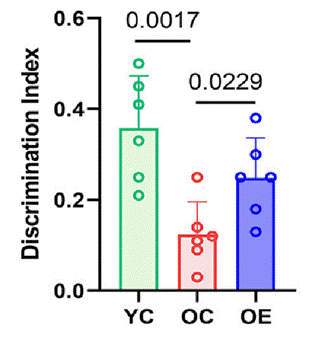
To confirm exercise’s cognition-enhancing effects, Xiao and colleagues subjected the old mice to a 16-week aerobic exercise regimen, where they ran for an hour five days a week. Following this exercise schedule, the researchers performed cognitive assessments to measure the effects on cognitive function. They found that, indeed, exercise improved measurements of memory, providing evidence confirming that exercise enhances cognition in old mice.
Xiao and colleagues then sought to find whether supplemental β-hydorxybutyrate recapitulates exercise-associated cognitive benefits. To do this, they first confirmed that supplemental injections with this exerkine increased circulating β-hydroxybutyrate levels, with the infusion nearly tripling circulating levels 15 minutes after the injection.
After confirming increased β-hydroxybutyrate levels in circulation, Xiao and colleagues used cognitive assessments to determine whether injections of the exerkine replicate the cognition-enhancing effects of exercise. Interestingly, they found that injecting with β-hydroxybutyrate was associated with improvements in assessments of memory. These findings suggest that β-hydroxybutyrate supplementation can alleviate age-related cognitive deficits, showing effects similar to those of exercise.
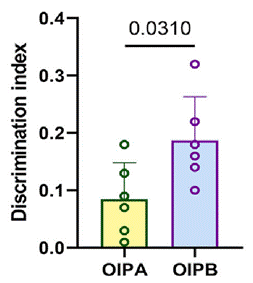
Aside from the evidence suggesting that β-hydroxybutyrate supplemental injections mimic the cognitive-enhancing effects of exercise in old mice, Xiao and colleagues ran other experiments to confirm that β-hydroxybutyrate is necessary, at least in part, for exercise’s cognitive benefits. These experiments included genetically manipulating old mice so that they lacked an enzyme involved in producing β-hydroxybutyrate. As such, these genetically altered old mice did not exhibit the same degree of cognitive enhancement from exercise as old, non-genetically manipulated mice. This finding provides further evidence that the β-hydroxybutyrate exerkine is indeed necessary, at least in part, for exercise’s association with improved cognition in old animals.
“This study identifies [β-hydroxybutyrate] as a central mediator of exercise-linked benefits…” say Xiao and colleagues in their publication. “Together, these findings position [β-hydroxybutyrate] as a pivotal signaling metabolite that couples exercise to cognitive improvement, and suggest that combining exercise with targeted, physiology-aligned [β-hydroxybutyrate] interventions may offer a translational avenue to mitigate age-related cognitive decline and neurodegenerative risk.”
Whether β-Hydroxybutyrate Supplementation Preserves Cognition in Older Humans
Research in humans has shown that boosting the body’s utilization of ketone bodies, like β-hydroxybutyrate, through fasting, supplementation, or dietary interventions, enhances brain network stability in young adults. According to a review, this finding supports the potential of β-hydroxybutyrate to protect the brain during aging. Conducting similar research in older adults could confirm that supplementing with β-hydroxybutyrate has similar effects during aging as it does in mice. Thus, the potential of β-hydroxybutyrate to preserve brain function and help against age-related neurological conditions like cognitive decline, mild cognitive impairment, and Alzheimer’s disease awaits human trial testing.
The data from Xiao and colleagues suggesting that β-hydroxybutyate serves as a key molecular mediator of exercise’s association with improved cognition during aging in mice helps build the case for supplementing with this compound during aging for cognitive preservation. For anyone interested in hedging a bet on the applicability of the mouse data behind this exerkine, a month’s supply of supplemental β-hydroxybutyrate powder is available for between $30 and $45.
Model: 19-month-old C57BL/6J mice
Dosage: β-hydroxybutyrate injections (200 mg/kg body weight) administered five times per week for 16 weeks
 Comments