


China Outpaces the US with New Standardized, Longevity-Focused Preventative Medicine
With an aging population and growing healthcare demands, China has launched a national education program in longevity medicine for physicians.
Highlights
- The newly introduced curriculum establishes a structured educational framework for physicians.
- The curriculum aims to cultivate a new generation of physicians who address age-related health challenges through evidence-based, preventive approaches.
- Contrasting with traditional, disease-focused models, this longevity-centered approach emphasizes extending healthspan—the number of years lived in reasonably good health.
In response to a rapidly aging population and the associated healthcare demands, China has initiated an education program in longevity medicine for physicians. What makes this program unique is that it will be part of a nationalized physician training system.
While longevity-focused medical education exists elsewhere (e.g., in the US and Europe), China’s program will be standardized nationwide with a government-linked rollout. As such, while medical programs in other global regions appear to be experimenting with longevity education, China will make it mandatory. China’s mandated, longevity-focused physician curriculum marks a significant leap toward integrating medicinal measures to optimize longevity, as well as preventive care, into mainstream clinical practice.
Non-Profit Organizations Behind China’s New Curriculum for Physicians
This initiative has been jointly developed by the China Non-Public Medical Institutions Association and the Asia-Pacific Longevity Medicine Society. For background, the China Non-Public Medical Institutions Association is a non-profit organization focused on professional standards, quality improvement, and academic exchange for the medical industry. Moreover, the Asia-Pacific Longevity Medicine Society is a newly established non-profit organization focused on promoting policies that favor longevity medicine and healthy aging throughout Asia.
More Information On the Longevity-Focused Curriculum for Physicians
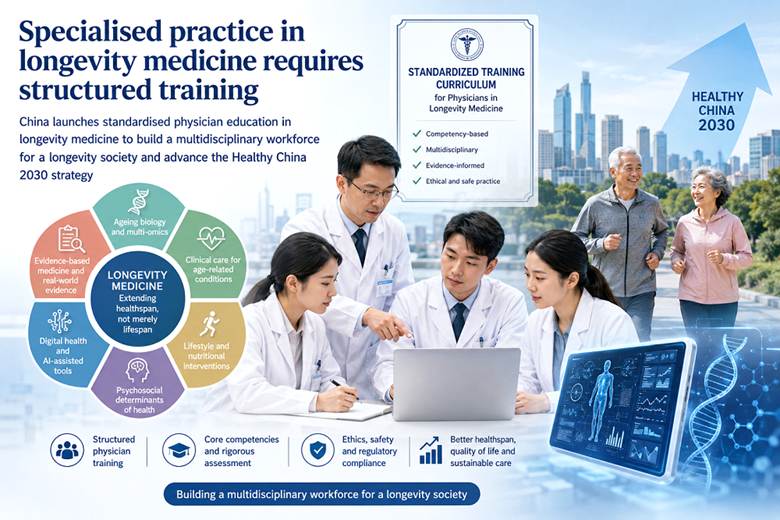
The curriculum for physicians has been dubbed the Standardized Training Curriculum for Physicians in Longevity Medicine. It will establish a structured educational framework for the emerging interdisciplinary field of longevity research. The program aspires to cultivate a new generation of physicians who have the capacity to address age-related health challenges through evidence-based, preventive measures that center on individual patients.
Moreover, the curriculum’s aims will align with the Healthy China 2030 strategy. This strategy entails a long-term national approach that was first released in 2016 and later carried forward through implementation starting in 2019, with plans to end in 2030. This approach treats health as a core priority for national development and emphasizes prevention, health equity, stronger healthcare systems, and healthier lifestyles rather than only treating diseases after they appear.
Accordingly, unlike traditional models of medicine that focus on treating diseases, the longevity medicine that will be taught in the new physician curriculum emphasizes extending healthspan—the years lived in overall good health. For patient healthspan extension, the curriculum will incorporate aging biology, management of age-related diseases, nutrition and exercise interventions, traditional Chinese medicine, psychological and social health, AI-assisted clinical decision making, and real-world evidence.
Which Physicians Will Receive Longevity Medicine Training
The curriculum will be mandatory for licensed physicians in the following fields: internal medicine (a field focusing on complex and chronic diseases), general practice, geriatrics (a field focusing on medical care for older adults), cardiology (heart medicine), endocrinology (a field focusing on hormones), and other related specialties. Physicians in these fields will complete structured coursework, learn about cases pertaining to aging, undergo supervised clinical practice, and perform competency assessments before receiving their certification in longevity medicine. As such, the longevity science curriculum for physicians in China represents a new paradigm grounded in longevity research.
“As populations age globally, healthcare systems must transition from reactive disease treatment toward proactive healthspan management,” said Dr. Tim Shi, President of the Asia-Pacific Longevity Medicine Society, in a press release. “This initiative is designed to help physicians identify opportunities for earlier intervention, preserve functional capacity, and improve quality of life throughout the aging process.”
The curriculum also puts a strong emphasis on medical ethics, compliance with regulations, communicating risks to patients, and evidence-based practice. Given the ongoing rapid expansion of aging intervention therapeutics, the use of nutritional supplements, and the development of digital health technologies, the curriculum highlights the importance of scientific rigor, patient safety, and responsible implementation in the clinic.
How China’s Longevity-Focused Curriculum for Physicians Differs from Curriculum Taught to US Physicians
A key differentiating aspect of physician training in the US, when compared with China, is that longevity education is more decentralized and variable. More specifically, medical school curriculum in the US requires studying each phase of the life cycle, but does not mandate formal longevity science training.
US physicians practicing internal medicine are required to complete at least one rotation in geriatrics, but the extent of their training is considered minimal compared to China’s full longevity curriculum. Also, for physicians who specialize in geriatrics, the curriculum focuses primarily on aging physiology, age-related diseases, cognitive function, mobility, and physical functioning status. However, the geriatrics specialization does not focus on healthspan extension as a core aim to the degree that the Chinese model does.
| Aspect | China’s longevity curriculum | American physician approach |
| Structure | National, standardized program | Distributed across specialties |
| Goal | Healthspan and proactive aging care | Disease management and function preservation |
| Content | Includes geroscience, AI, biomarkers, lifestyle, and ethics | Mostly specialty-based aging care and geriatrics |
| Training status | Certification-oriented pathway | No single universal longevity certification path |
Thus, China’s implementation of a longevity science curriculum for physicians across specializations could mean that this nation is paving the way for effective longevity-focused interventions and patient care. Only time will tell if China’s new curriculum will significantly extend the healthspan and average lifespan of Chinese residents. It will also be interesting to see whether other countries across the globe follow suit and implement similar training programs for their physicians.
 Comments