


Citrulline Supplementation Reduces Inflammation and Reverses Aging Markers in Aged Mice
Restoring citrulline levels reduces inflammation and reverses aging markers in aged mice, researchers find.
Highlights
- Citrulline levels decline with age across multiple tissues.
- Restoring citrulline reduces inflammation and cellular damage.
- Citrulline improves immune function and reverses aging markers in mice.
Aging is associated with changes in how the body processes and uses nutrients. Some naturally occurring molecules increase over time, while others steadily decline. Although many of these shifts have been documented, it remains unclear whether they simply reflect aging or actively contribute to it.
In a recent study published in Science Advances, researchers identified the amino acid citrulline as one that consistently declines with age and contributes to changes in immune function. Restoring citrulline levels reduced markers of cellular aging and lowered inflammatory signaling in both aged cells and aged mice. The study further showed that citrulline improved tissue health and reduced DNA damage in aged animals, linking age-related metabolic decline to inflammation and cellular dysfunction.
Researchers Identify Citrulline as a Consistently Reduced Metabolite
To examine how metabolism changes over time, the researchers measured small molecules in the brain, liver, and blood of mice at different ages. This type of analysis allows scientists to track how the body’s chemistry shifts across tissues. While many molecules changed in individual organs, only a few showed the same pattern everywhere.
Citrulline was one of the few that consistently decreased across all three tissues. In the liver, levels dropped by about half, early in adulthood, while smaller but steady declines were observed in the brain and blood. These findings suggest that citrulline decline affects multiple organs simultaneously.
Citrulline Reduces Cellular Aging and Inflammatory Signaling in Aging Cell Models
To determine how citrulline affects aging at the cellular level, the researchers first studied mouse cells that had been experimentally pushed into an aging-like state. These cells were exposed to oxidative stress, which causes damage and drives them into a senescent state where they stop dividing and begin releasing inflammatory signals. Under these conditions, citrulline levels declined, mirroring the patterns observed in aging animals.
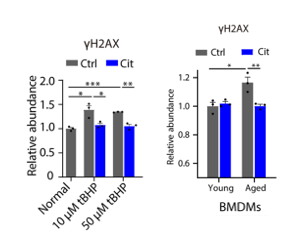
When citrulline was added back, several markers of cellular aging were reduced. DNA damage declined, and the activity of senescence-associated β-galactosidase, a standard indicator of cellular aging, was lower. In addition, cells produced fewer proteins that prevent division, indicating a partial restoration of their ability to replicate.
The researchers also examined the senescence-associated secretory phenotype, a process in which aging cells release high levels of inflammatory signaling molecules that affect surrounding tissue. Citrulline supplementation reduced the production of key inflammatory molecules in these aging cells. These effects were not observed in non-senescent cells, indicating that citrulline specifically targets pathways that become dysregulated with age.
To test whether these effects extend to immune cells, the researchers examined macrophages isolated from both young and aged mice. Macrophages are immune cells that play a central role in regulating inflammation and are major contributors to age-related tissue damage. In aged macrophages, citrulline levels were significantly reduced compared to younger cells. When citrulline was restored, markers of DNA damage and cellular aging declined, and the production of inflammatory signaling molecules was reduced.
Similar effects were observed in human immune cells, where citrulline lowered inflammatory signaling in macrophages derived from older individuals. Together, these findings demonstrate that citrulline exerts its effects across multiple cell types, reducing cellular aging and limiting the release of inflammatory signals that contribute to tissue dysfunction.
Citrulline Supplementation Improves Aging-Related Changes in Mice
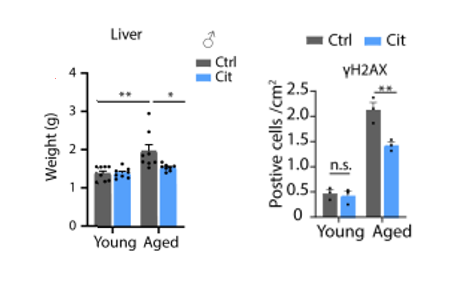
To test whether the reductions in inflammation and cellular aging observed in isolated cells also occur in living organisms, the researchers gave citrulline to older mice over several weeks. This increased citrulline levels throughout the body and led to measurable improvements in several markers associated with aging. Levels of inflammatory signals decreased in both the brain and liver, and indicators of cellular damage were reduced.
In addition, the size of organs, such as the liver and spleen, which often increase with age due to inflammation and metabolic stress, was smaller in mice receiving citrulline. Body weight also declined modestly in older mice, while younger mice showed no change. These findings show that restoring citrulline levels improves multiple features of aging without broadly altering normal physiology.
Targeting Metabolic Decline May Improve Aging Outcomes
Together, these findings show that citrulline deficiency contributes directly to aging-related changes in immune function and inflammation. Restoring citrulline levels improves cellular health, reduces inflammatory signaling, and reverses several markers of aging in animal models. The results also highlight how targeting specific metabolic changes can influence multiple aspects of aging at once.
Evidence from human studies suggests that citrulline may affect similar biological systems. Clinical data show that citrulline supplementation improves blood vessel function in middle-aged and older adults, including measures of how effectively blood vessels relax and respond to changes in blood flow. Additional studies report improvements in microvascular function and muscle performance, including increased blood flow in small vessels and gains in muscle strength in individuals with metabolic disease.
These findings are consistent with the role of citrulline in regulating circulation and tissue function, both of which decline with age. While further research is needed to determine whether citrulline can directly reverse aging-related changes in humans, the available evidence supports its role in pathways that influence inflammation, vascular health, and physical function.
Model: Naturally aged male mice: Young controls: 6 weeks old. Aged mice: 72 weeks old at study initiation
Dosage: 1 g/kg/day of citrulline administered in drinking water for approximately 9 weeks
 Comments