


Citrus Fruit Peel Molecule Improves Skin and Counters Cell Senescence, New Study Shows
Hesperetin, a molecule found in citrus fruit peels, reduces skin aging from both UV light and natural aging in mice, and there is evidence for this working in humans.
Highlights
- Hesperetin has previously been shown to activate a gene that extends the lifespan of mice called CISD2, which is reduced in human skin tissue exposed to the sun.
- Supplementing mice exposed to UV radiation with hesperetin counters skin aging effects such as wrinkles.
- Hesperetin supplementation also rejuvenates the skin of naturally aged mice.
Our skin ages—wrinkles, thins, dries out, structurally breaks down, etc.—from within and without. From within, our skin ages due to factors like inflammation and the accumulation of dysfunctional cells called senescent cells. From without, the ultraviolet (UV) light that radiates from the sun is the main cause of skin aging (photoaging).
In a recent study published in the Journal of Biomedical Science, researchers from National Yang Ming Chiao Tung University in Taiwan have found that hesperetin protects against skin aging from within and without. They show that a gene called CISD2 is lower in human skin tissues exposed to the sun. Hesperetin, which activates CISD2, was found to counteract both UV-induced skin aging and rejuvenate aged mice. These effects were attributed to factors such as cellular senescence.
CISD2 Helps Mice Live Longer
Scientists consider CISD2 a longevity gene, in part because it prolongs mouse lifespan. More specifically, it extends the lives of genetically altered mice that have higher-than-normal levels of CISD2. Notably, these genetically modified mice exhibit improvements in their muscle, neurons, and skin, suggesting CISD2 delays skin aging. Conversely, the absence of CISD2 prematurely ends the lives of mice genetically altered to have little-to-no CISD2, without promoting premature skin aging. These findings suggest that CISD2 may be a potential biological modulator of aging, including skin aging.
Sun Exposure May Lower CISD2 Levels in Human Skin
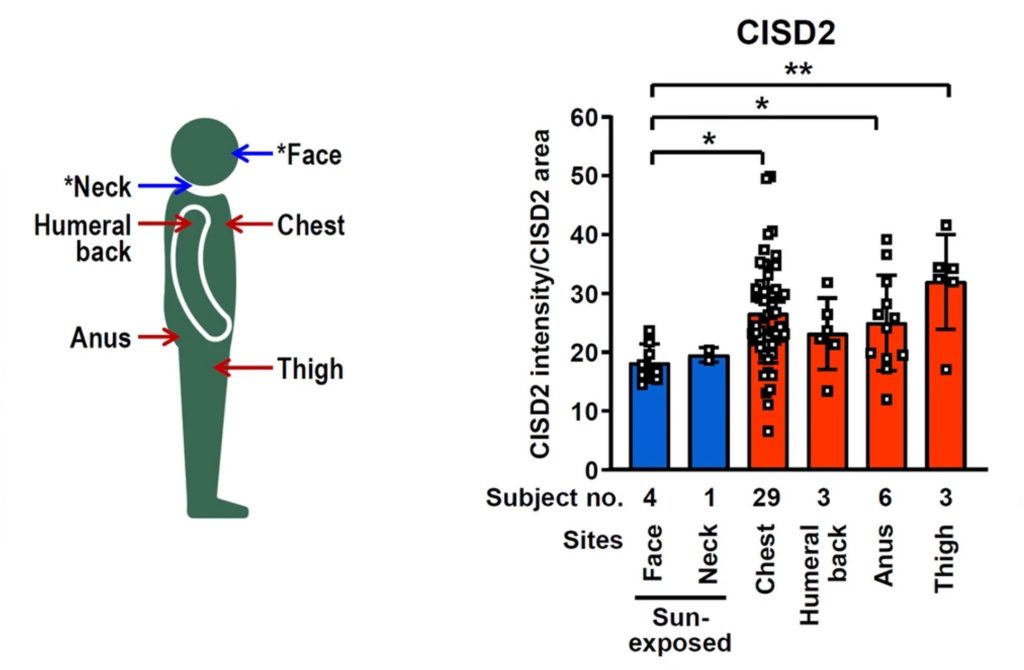
To determine the relevance of CISD2 in human skin, the National Yang Ming Chiao Tung University researchers examined skin samples taken from various regions of the body. They found that CISD2 was lower in skin from the neck and face compared to skin from the anus, thigh, arm, and chest. From this, the researchers surmised that sun exposure may lower CISD2 levels in the skin.
Hesperetin Mitigates UV-Induced Redness and Wrinkles in Mice
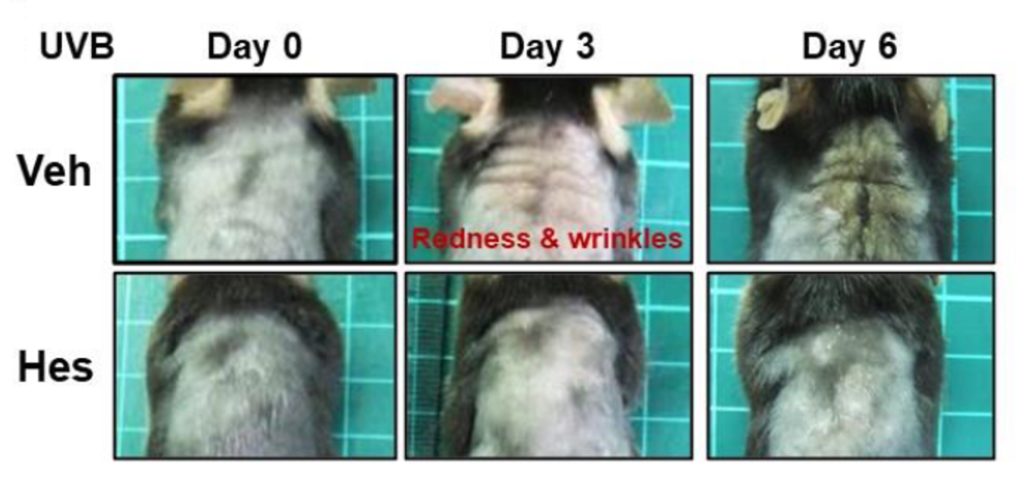
In a previous study, the Taiwanese researchers found that hesperetin prolongs the lifespan of mice by activating CISD2. Because CISD2 appears to diminish in areas of the skin exposed to the sun, they tested whether hesperetin could counteract UV-induced skin aging. First, they injected mice with hesperetin, then they exposed the mice to UV radiation. Just five days of UV exposure led to a 50% reduction in skin CISD2.
Surprisingly, hesperetin treatment not only restored CISD2 but also increased it beyond normal levels. Hesperetin treatment also protected the skin from redness and wrinkles. At the molecular level, hesperetin reduced reactive molecules called reactive oxygen species (ROS) and reactive nitrogen species (RNS), which are thought to contribute to cellular damage and skin aging. A protein called MMP-1, which breaks down structural proteins like collagen, was also reduced by hesperetin treatment.
When the researchers genetically deleted CISD2 in mice, the protective effects of hesperetin were abolished, confirming that its anti-photoaging activity depends on CISD2 activation. Notably, oral administration of hesperetin proved equally effective as intravenous delivery, indicating strong bioavailability and therapeutic potential without the need for injections.
Hesperetin Rejuvenates the Skin of Mice
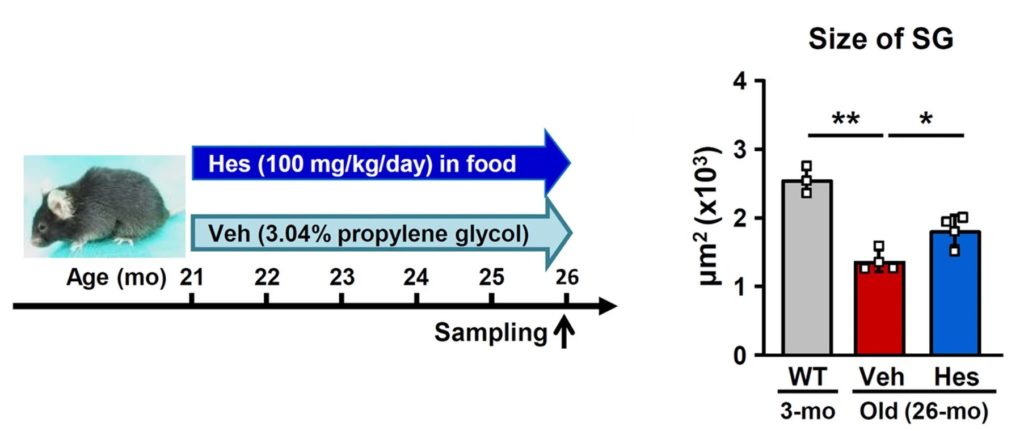
Although UV radiation induces molecular changes that closely resemble those seen in intrinsic (aging from within) skin aging, it does not fully recapitulate the natural aging process. To address this, the researchers examined age-related changes in CISD2 and found that its levels decline in the skin of older mice. They then administered hesperetin (100 mg/kg/day) to 21-month-old mice, roughly equivalent to 63-year-old humans.
Hesperetin treatment restored skin CISD2 levels to those observed in young mice and alleviated several hallmarks of skin aging, including dermal thinning, hair loss, and reduced sebaceous gland size. Because sebaceous glands produce fats that help maintain skin hydration and elasticity, their preservation is linked to reduced wrinkle formation. At the molecular level, hesperetin also lowered reactive oxygen and nitrogen species (ROS and RNS), consistent with reduced cellular damage.
Hesperetin Targets Aging at the Cellular Level
To study aging at the cellular level, the researchers examined skin cells from a 65-year-old man. They first examined mitochondria, which, having a particular voltage, are like cellular batteries. Treating the aged human skin cells with hesperetin improved the voltage of the mitochondria while also elevating cellular energy (ATP) levels, suggesting that hesperetin counters the mitochondrial dysfunction associated with aging.
Hesperetin also reduced ROS levels, as it did in mouse skin, supporting its role as an antioxidant. Moreover, when the researchers exposed the aged human skin cells to UV rays, there was an increase in the collagen-degrading enzyme MMP-1. Similar to in mouse skin, hesperetin treatment countered the UV-induced elevation in MMP-1.
Cellular Senescence
In response to stressors from outside of the body, such as UV radiation, or stressors from inside the body, such as mitochondrial dysfunction or excess ROS levels, our cells enter a senescent state. Especially in skin cells, this altered state may protect against the spread of cancerous cells by halting cell division. In turn, senescent cells are thought to be removed by the immune system. However, with aging, senescent cells tend to accumulate in the skin and other tissues, perhaps due to a weakened immune system.
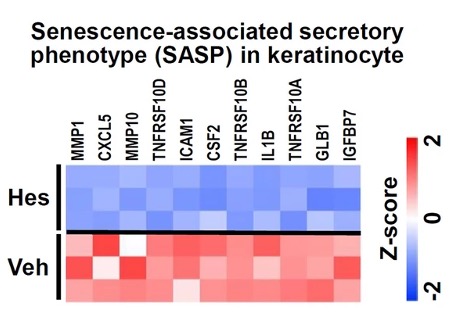
By analyzing the genes of aged human skin cells, the researchers found that genes associated with senescent cells were elevated, but this elevation was reduced by hesperetin treatment. Senescent cell accumulation promotes tissue breakdown, as senescent cells secrete molecules that slowly degrade the tissues they inhabit. These molecules, collectively known as the SASP (senescence-associated secretory phenotype), include tissue-degrading enzymes and pro-inflammatory molecules. The researchers showed that hesperetin reduced at least 11 SASP factors, including MMP1, as measured by mRNA levels in aged human skin cells.
“Here we provide evidence for and demonstrate that the pharmacological elevation of CISD2 protein levels at a late-life stage is feasible and that such an increase attenuates both intrinsic aging of skin (i.e., aging via time per se) and extrinsic aging of skin (e.g., aging by sunlight and UV radiation),” said the authors of the study.
Taking Hesperidin to Elevate Hesperetin
Hesperidin, like hesperetin, is a molecule found in citrus fruit peels, but in higher abundance than hesperetin. Hesperidin, available in supplement form, is composed of hesperetin and another molecule called rutinose. Studies show that hesperetin is poorly absorbed into the bloodstream upon intake. However, when hesperidin is consumed, it is cleaved into hesperetin and rutinose in the gut, allowing for the absorption of hesperetin into the bloodstream. It follows that taking a hesperidin supplement may elevate hesperetin levels in the body.
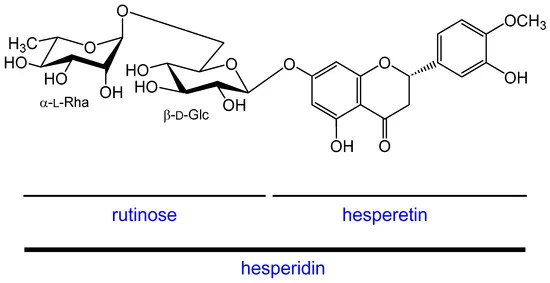
However, the authors of the study suggest that hesperetin itself should be developed as a supplement or topical treatment:
“Hesperetin is the first compound that we have tested as a proof-of-concept for the hypothesis that a CISD2 activator has an anti-aging effect on the skin. Therefore, it is of great interest to begin to develop hesperetin either as a functional food or as a skincare product for topical treatment, with the aim of slowing down and/or rejuvenating aging skin via an enhancement of CISD2.”
Model: 21-month-old male C57BL/6 mice
Dosage: 100 mg/kg/day of orally administered hesperetin for 5 months
 Comments