


Engineering the Future: The AI Revolution in Aging Science
A new perspective article explores how artificial intelligence (AI)-based coordinated research may revolutionize the fight against aging.
Highlights
- Researchers propose integrated hubs, communities of researchers and residents consolidated within geographical regions, to overcome obstacles to longevity research and development, such as high costs and low success rates of new therapeutics.
- Integrated hubs would harness the power of AI to analyze health-related data from residents to potentially uncover mechanisms of aging that human researchers cannot typically perceive.
- These integrated hubs are roughly based on futuristic cities, like TODTOWN in China and NEOM in the Saudi Arabian desert.
According to a new perspective on longevity research by Zhavoronkov and Leung, published in Aging and Disease, the rising costs, extended timelines, and low success rates for experimental therapies targeting aging require that researchers rethink the biotechnology research and development pipeline. For example, the cost to bring a new drug to market has dramatically increased from an estimated $1.8 billion in 2010 to over $6.1 billion in 2020. Not only that, but timelines for new drug development equate to about 10 to 20 years. Compounding this, the success rates of new drugs remain very low, with only about 8% of new drugs that enter clinical trials receiving full regulatory approval.
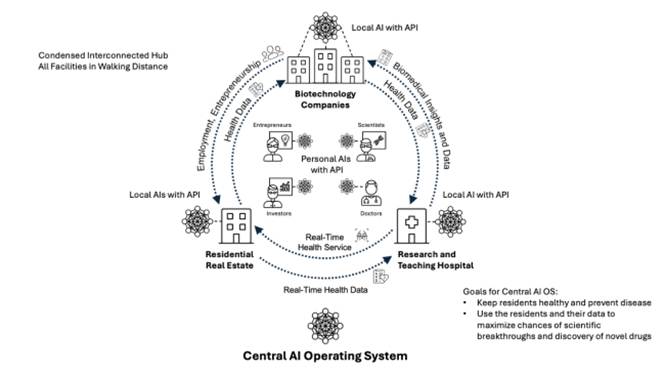
For these reasons, Zhavornokov and Leung propose that the biomedical research industry needs a shift in strategy to continue sustainable growth and that the output of longevity research needs to become more integrally ingrained in society. Along these lines, the aging researchers suggest a new model for longevity biotechnology research and development. This would entail the development of what they call integrated hubs, artificial intelligence (AI)-driven ecosystems with residential, commercial, clinical, and research infrastructure.
These integrated hubs are conceived as purpose-built environments designed to address common barriers in the current research and development landscape. Accordingly, through the leveraging of real estate assets used to create a unified community, the integrated hubs model aims to reduce risk in investments and accelerate discovery, creating a more productive and efficient pipeline for innovation in longevity research.
A New Paradigm Harnessing Integrated Biotechnology Hubs
The integrated hubs are purpose-built communities that would be founded on five key infrastructure elements: advanced residential real estate, commercial amenities, biotech research facilities, a hospital for research, and an AI operating system that unifies the entire community. With these elements, the integrated hubs would connect distinct user groups: resident researchers, biotech firms, the hospital, and tenants. The integrated hubs’ value would come from network effects: more and more residents who produce high-quality longevity-related data spanning over time, which biotech firms would find valuable, would in turn fund better amenities for residents as well as research tools, attracting more top talent.
As far as the advanced residential real estate goes, residents would live in smart homes, which use internet-connected devices to automate and control household functions like lighting and security, within the integrated hubs. The homes would also provide personalized data on longevity-related health parameters and lifestyle habits, identifying disease-associated deviations and giving lifestyle coaching. The health-related data from these homes would also be relayed to a central AI operating system for continuous AI-based refinement of treatments and lifestyle coaching.
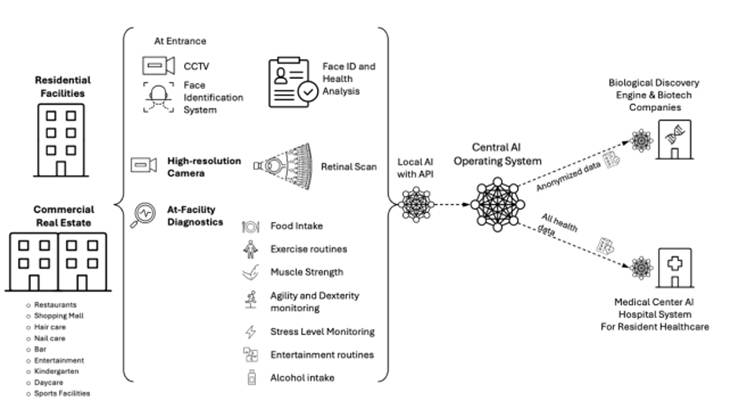
Moreover, the commercial amenities would entail the installation of various commercial, lifestyle, and retail stores, such as those selling groceries or electronics. The overarching purpose of having commercial amenities would be to promote the health and satisfaction of integrated hub residents.
Also, the biotechnology research facilities would be incorporated into the communities to maximize the development of innovative healthcare strategies for the betterment of the world’s population. All the while, these research facilities would help provide the community’s residents with optimal living and working conditions. Furthermore, the research facilities would provide resident researchers with a network of resources and services that support longevity research’s unique needs.
The research hospital incorporated into the community would have a dual purpose, providing residents with advanced healthcare and leveraging the massive amounts of data from smart homes and clinical settings to conduct research studies. As such, the central hospital would have a central facility to collect, store, and analyze voluminous amounts of health-related data, including patient tissue samples, lifestyle monitoring data, and other data obtained in clinical settings. The central location of the research hospital would also help integrate researchers for medical data exchange.
Finally, the AI-based operating system would be designed to effectively accelerate and enhance coordinated research efforts, all the while protecting patient privacy. The AI operating system would also assist researchers in uncovering patterns in longevity-related data, which most humans would not typically have the ability to perceive, to solve complex problems of aging biology.
Similar Projects Underway in China and Saudi Arabia
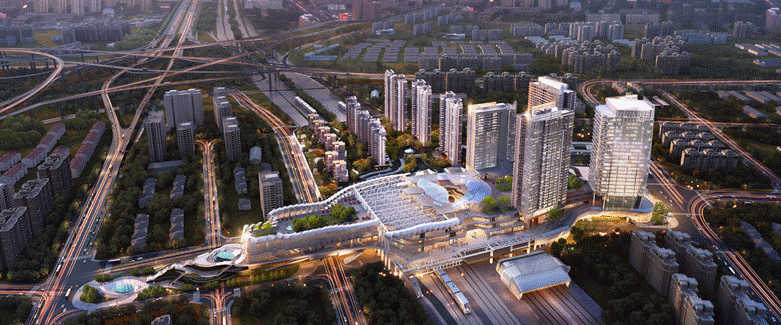
One project with a similar theme to that proposed by Zhavoronkov and Leung is TODTOWN in Shanghai, China. TODTOWN is a community that has integrated commercial, residential, and public space, intending to be a model for sustainable urban living. Somewhat like what Zhavoronkov and Leung have proposed with integrated hubs, TODTOWN collects health-related data from residents.
Another example of a similar real-world test of Zhavoronkov and Leung’s conception is the community of NEOM in Saudi Arabia. NEOM is known as a “cognitive city,” powered by AI and data. NEOM also aims to promote the health and longevity of its residents with the help of AI-based data analysis.
Gaining Perspective on Integrated Hubs
Zhavoronkov and Leung’s conception of integrated hubs, roughly based on other community hubs like TODTOWN and NEOM, may harness massive data collection and AI-based analyses to accelerate longevity biotechnology research and development. Whether such integrated hubs will provide the infrastructure needed to overcome significant obstacles for new longevity therapies, such as rising costs and low success rates, awaits testing to see how these communities perform.
 Comments