


Can Fish Oil Fix a Bad Diet? New Science on Protecting Cells from Junk Food
Scientists find that administering a fish oil supplement to mice on a diet high in potato chips counteracts changes to the gut microbiome that promote accelerated aging.
Highlights
- Fish oil reduces “bad” cholesterol, blood glucose levels, and weight gain in mice that eat fried food every day.
- Fish oil also counteracts the liver and metabolic dysfunction induced by excessive fried food consumption.
- Fish oil restores balance to the gut microbiome, which may contribute to the above benefits.
The process of frying foods leads to the generation of toxic chemicals that are linked to chronic age-related diseases, including diabetes, obesity, and liver disease. However, the precise mechanism by which fried food consumption leads to age-related metabolic diseases, in the context of fry-generated chemicals, is not well defined.
With this in mind, researchers from China tested whether the ill effects of fried foods, such as inflammation, could be ameliorated. To do so, they chose a dietary intervention known for its metabolic and anti-inflammatory properties: fish oil. As published in Food Frontiers, the researchers found that fish oil can mitigate, or even prevent, many of the age-accelerating effects of fried foods.
Fish Oil Reduces Cholesterol, Blood Glucose, and Weight
To study the detrimental effects of fried food consumption, the researchers fed mice a diet consisting of 30% potato chips. While most individuals do not consume this amount of potato chips per day, a significant proportion of Americans consume fast food every day. Like potato chips, fast food is high in saturated fat and processed carbohydrates while also being low in vitamins and minerals. Notably, the 30% potato chip diet was previously shown to induce metabolic defects in rats.
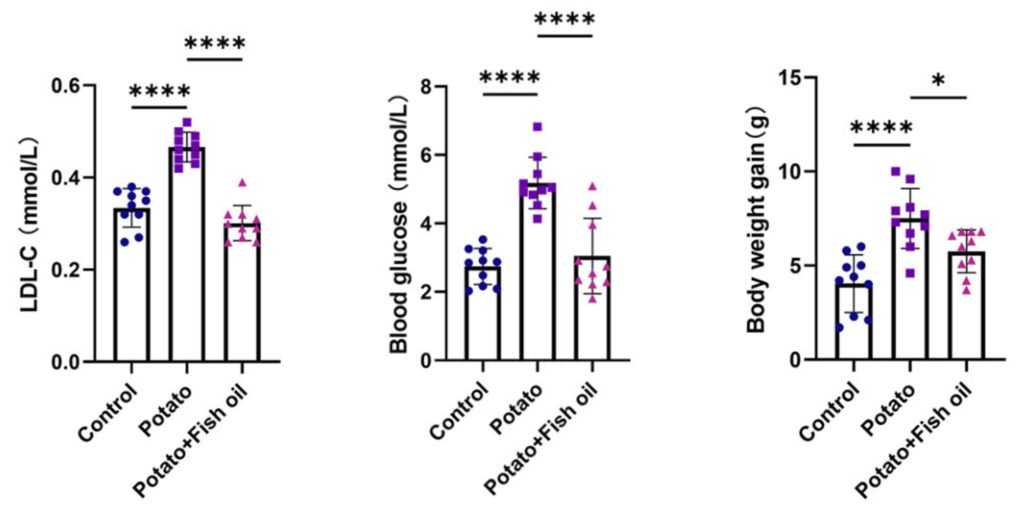
Taking it further, the Chinese researchers administered fish oil supplements to mice on the high potato chip diet. Remarkably, the fish oil prevented a host of metabolic defects, including high LDL cholesterol, which is a risk factor for cardiovascular disease. The fish oil also prevented elevations in blood glucose. What’s more, the fish oil significantly reduced potato chip-induced weight gain. These findings suggest that fish oil may contribute to counteracting type 2 diabetes and obesity.
Fish Oil Counteracts Liver Aging and Metabolic Dysfunction
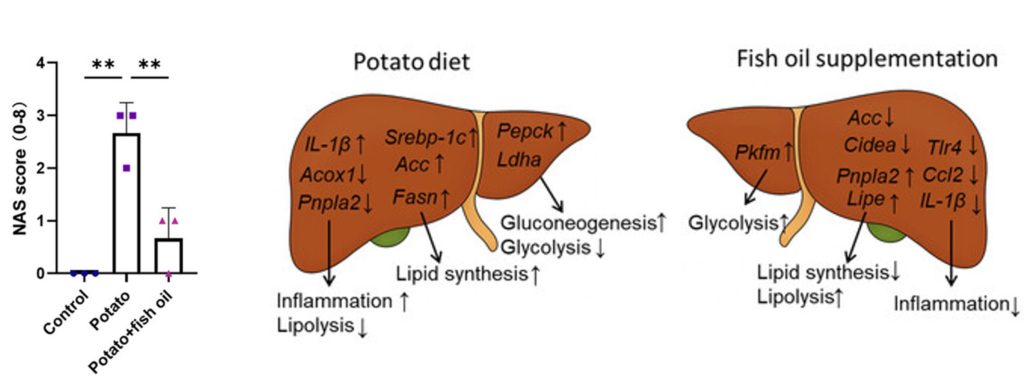
After 13 weeks of excessive potato chip consumption, the mice were examined for organ damage. Along with other measures, the NAS (non-alcoholic fatty liver disease activity score) was used to assess the liver, revealing that high potato chip consumption triggers moderate liver damage. However, fish oil supplementation not only reduced the NAS but also inflammatory immune cell infiltration and fat accumulation in the liver. Considering that such defects occur with aging, these findings suggest that fish oil counteracts liver aging induced by eating fried foods.
In the liver, aging leads to a reduction in fat breakdown and an increase in fat storage. Upon analyzing changes in gene activation in the liver, the researchers found that the potato chip diet induced both of these defects. However, along with reducing pro-inflammatory genes, fish oil supplementation reduced these defects. Fish oil also counteracted genes associated with the production of glucose, which could explain the reduction in blood glucose levels observed. Notably, fish oil was also shown to counteract the loss of insulin-secreting β-cells, which also likely contributes to improving blood glucose levels.
The Role of the Gut Microbiome
Our gut microbiome consists of the trillions of microbes living in our gastrointestinal tract. These microbes, particularly bacteria, secrete molecules that enter the bloodstream and affect our physiology, for better or for worse. Some bacterial strains, called probiotics, secrete beneficial molecules, while other bacterial strains secrete harmful molecules. Thus, a healthy gut microbiome will ideally have a good balance of probiotics and minimal harmful bacteria.
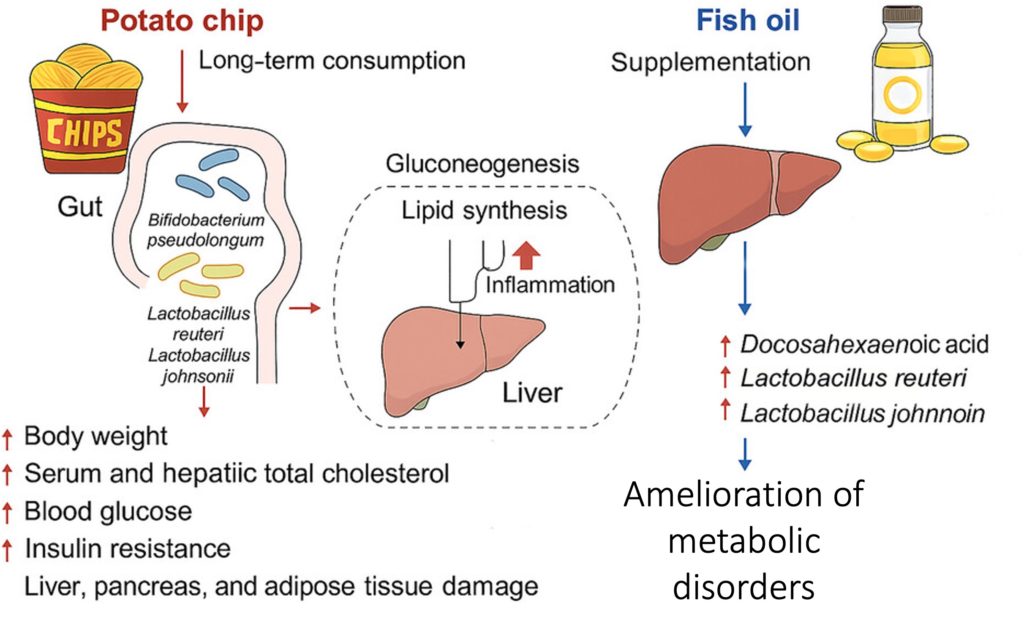
With that said, the China-based researchers found that several strains of probiotics, associated with protecting against obesity and diabetes, were reduced in mice fed the potato chip diet. These probiotics are known to secrete short-chain fatty acids, which are linked to beneficial physiological effects, such as reduced inflammation. Thus, the impairments observed in mice fed a large amount of potato chips, such as weight gain, liver dysfunction, and metabolic dysregulation, were attributed to a lack of these probiotics.
Strikingly, however, fish oil supplementation mitigated the loss of these probiotics while also raising the omega-3 fatty acid DHA (Docosahexaenoic acid). Together, these results suggest that fish oil counteracts the weight gain, metabolic dysregulation, organ damage, and gut microbiome imbalances induced by excessive potato chip consumption. These results also suggest that fried foods accelerate aging, which can be countered with fish oil.
Taking Fish Oil to Counteract Processed Food-Induced Aging
Fish oil is one of the most well-studied anti-aging interventions. An analysis of 7 studies showed that fish oil improves waist circumference and counteracts liver and metabolic dysfunction, supporting the findings of the China-based researchers. Furthermore, an analysis of 40 studies showed that fish oil supplementation reduces the probability of having a heart attack. Additionally, an analysis of 9 studies showed that fish oil improves learning, memory, cognitive well-being, and blood flow in the brain.
However, there is a lack of human studies exploring the effect of fish oil on processed food-induced impairments. Nevertheless, there are at least two animal studies related to this. One study showed that fish oil, specifically DHA, counteracts cognitive impairments in aged rats fed a Western-style diet. Another study showed that DHA does the same in aged rats fed a diet high in refined carbohydrates, a feature of many processed foods. Thus, while human studies are needed, it would seem that fish oil can counteract processed food-induced aging.
When it comes to dosage, about 2 grams of fish oil, containing at least 500 mg of DHA, may be enough to counteract the ill effects of consuming processed food. Notably, consuming fatty fish, such as salmon, two to three times per week, should reap the same benefits as supplementation while also providing additional nutrients, such as vitamin D and protein.
Model: C57BL/6J mice
Dosage: 3200 mg/kg/day of fish oil (48% EPA and 19% DHA) for 13 weeks
 Comments