


Gene Therapy for Aging: New Advances That Could Extend Lifespan
Gene therapies from the biotech company BioViva targeting aspects of aging include one for physical performance enhancement and another for improved cognition.
Highlights
- The CEO of the biotech company BioViva, Liz Parrish, underwent gene therapy to extend the protective caps at the ends of her chromosomes (called telomeres).
- After undergoing another gene therapy to increase a protein called follistatin, Liz Parrish exhibited significantly higher levels of lean muscle mass in her thighs.
- A study of a gene therapy that increases the protein klotho, applied to patients with dementia, demonstrated improved cognitive test scores following therapy.
Nowadays, a large swath of the human population spends approximately 30% of their lives in relatively poor health, with one or more age-related diseases. Not only can such conditions associated with aging shorten people’s lifespans, but they also shorten the duration of life spent in optimal health (a concept known as healthspan).
In an effort to counteract the ravages of aging and age-related conditions, a company called BioViva has opted to develop gene therapies targeting hallmarks of aging. These gene therapies involve using genetic material to treat, prevent, or cure the processes of aging. In the case of gene therapies that BioViva employs, it uses engineered viruses stripped of their disease-causing components to deliver genetic material into cells.
In a YouTube segment, BioViva’s CEO, Liz Parrish, relayed background on and some promising data associated with a few of the company’s gene therapy techniques. In that regard, BioViva has developed a gene therapy meant to lengthen the protective DNA caps at the ends of chromosomes (telomeres), a gene therapy to increase the protein follistatin to improve physical performance, and a gene therapy to boost levels of the protein klotho to enhance cognition in older people.
Data On Gene Therapies to Lengthen Telomeres, Boost Muscle Function, and Improve Cognition
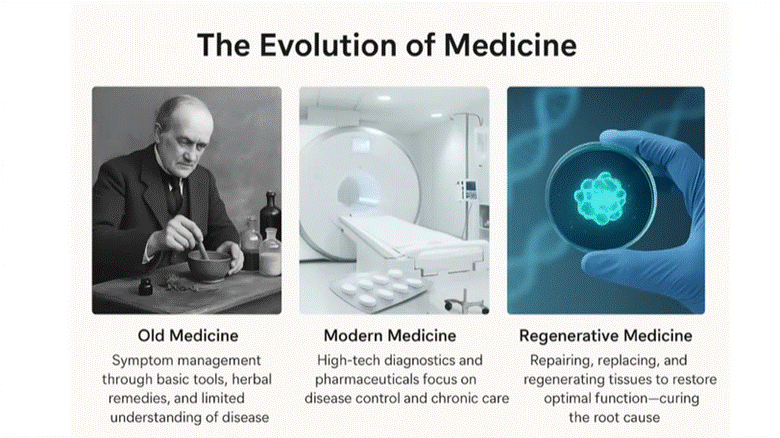
For starters, Parrish discussed the rationale behind using gene therapy to counteract the ravages of aging. Along those lines, today’s medicine entails using diet, exercise, and pharmaceuticals to treat age-related conditions. However, Parrish believes that medicine is in the process of shifting toward regenerative medicine, which encompasses repairing, replacing, and regenerating tissues with gene therapy to restore optimal physiological function. Using gene therapy for regenerative medicine, Parrish said that she hopes therapeutics will have the capacity to restore people’s physiology to a point that significantly delays death.
Moreover, Parrish stated that using gene therapy involves inserting genetic material into cells that only upregulate the expression of targeted proteins. In doing so, clinicians can take a “set it and forget it” approach, where patients do not need a booster gene therapy for a number of years after the initial treatment.
Parrish also presented some of the data supporting the potential of gene therapy techniques to counteract aspects of aging. Some of the data presented pertained to a gene therapy that increases the enzyme telomerase reverse transcriptase (TERT), which lengthens telomeres.
Interestingly, Parrish underwent this gene therapy, and the data she relayed showed that the therapy was associated with extensive telomere lengthening. In that regard, for each year following the therapy, her telomeres lengthened so that age measurements based on telomere length suggested that she became about 5.3 years younger.
Also, Parrish presented data for a gene therapy that increases follistatin, a protein that is believed to increase muscle mass through its inhibition of a muscle degradation-promoting protein called myostatin. As far as the data on follistatin gene therapy goes, after treatment, her thighs exhibited gained muscle mass and loss of fat between muscles. This result came even though Parrish engaged in less physical activity after follistatin gene therapy than before. This finding suggests that, even without lots of physical activity, follistatin gene therapy can confer lean muscle gains and fat loss.

Finally, Parrish presented data for a gene therapy that increases the protein klotho. Klotho is a protein believed to have pro-longevity benefits, and increasing klotho has been shown to extend lifespan in animal models.
Interestingly, after clinicians administered klotho gene therapy to patients with dementia, the patients’ scores on cognitive tests increased significantly. Not only that, but measurements of biological age—a measurement of age based on how well cells and tissues function—dropped significantly as well.
Parrish also relayed that IQ scores typically increase 10 to 14 points following klotho gene therapy. If accurate, this means that klotho therapy could potentially significantly boost cognition.
“What that can mean for a low-functioning person is becoming a bit higher functioning,” relayed Parrish. “For a higher functioning person, it can tip them over into more abilities, and for a really intelligent person, it can tip them over into genius.”
Substantiating the claim that klotho gene therapy can significantly improve IQ scores will require large-scale human trials. Along these lines, older adults will need to undergo this gene therapy and undergo follow-up evaluations testing their IQ at as yet undefined intervals after therapy to verify that their scores improve. For this reason, it remains unclear what data Parrish is reflecting on with her claim, drawing her statement into question.
Costs Associated with Anti-Aging Gene Therapies
Most of the gene therapies BioViva offers are given outside of the US in countries like the Bahamas, likely because regulations related to proving safety and efficacy are more lax in those locales. Accordingly, not enough data exists yet proving the safety and efficacy of gene therapies to perform these procedures in the US. Once researchers gain more traction in proving the safety and efficacy of these gene therapies, though, which Parrish says is underway, it could be the case that these procedures designed to counteract aspects of aging eventually become available in the US.
For anyone wanting to undergo an experimental gene therapy to potentially counteract an aspect of aging, gene therapy to extend telomeres costs anywhere between $2.5 million and $3.5 million for a single dose. Moreover, klotho gene therapy may cost a mind-boggling price of millions of dollars for a single dose. Maybe somewhat more affordable, follistatin gene therapy costs around $25,000 per treatment. While these prices seem steep and likely make gene therapies unattainable for most, Parrish lamented that she hopes the prices for most gene therapies fall well under $100,000 once the market for them grows and their administration is scaled to meet future demands.
 Comments