


Human Trial Shows Ginseng Compound Increases Muscle Mitochondria After Exercise in Aged Women
The compound Rg1 stabilizes sex hormone levels, increases stem cells in muscle tissue, and boosts cell powerhouse (mitochondria) numbers in muscles following a bout of exercise in older women.
Highlights
- One hour after ingesting 10 mg of Rg1, older women completed four sets of leg presses, which increased the number of stem cells with high mitochondrial content in their muscles.
- Stem cells deliver mitochondria to muscle fibers to replenish their cell energy-generating capacity.
- While exercise alone reduced circulating levels of sex hormones, Rg1 restored them to pre-exercise levels, linking Rg1’s effects on muscle mitochondria to stabilized hormone levels.
Resistance exercises, such as leg presses, serve as potent ways to increase muscle mass and strength; however, these muscle-enhancing benefits decline with age. Moreover, in aged, postmenopausal women, reduced levels of sex hormones likely contribute to a lower production of stem cells that support muscle repair after exercise.
Along these lines, the ginseng root-derived compound Rg1 has a similar molecular structure to sex hormones like estrogen. In fact, some research suggests Rg1 shows estrogen-like properties, mimicking the cellular effects of estrogen. This presents the possibility that supplementing with Rg1 could modulate hormone signaling to alleviate the impaired stem cell function and muscle rebuilding capacity associated with aging.
To evaluate Rg1’s sex hormone-modulating potential during aging, as published in the Journal of Ginseng Research, scientists from the University of Taipei in Taiwan assessed the effects of Rg1 supplementation in aged, postmenopausal women following a bout of exercise. They found that Rg1 reversed an exercise-induced depletion of the sex hormone estrogen and doubled the sex hormone progesterone in the blood. Moreover, exercise alone depleted stem cells that enter areas around muscle fibers, while Rg1 supplementation coupled with exercise increased their abundance. Furthermore, exercise alone failed to boost muscle mitochondria, but coupling exercise with Rg1 substantially increased muscle mitochondrial abundance.
These findings provide the first human trial evidence showing that Rg1 supplementation restores sex hormone levels following exercise in postmenopausal women. The findings also provide data showing that Rg1 enhances mitochondrial transfer from stem cells to muscle to potentially improve muscle recovery. Collectively, the results from this study support the notion that Rg1 can improve muscle recovery following exercise in aged women, underscoring the need for more human trials testing the compound’s effects on muscle recovery.
Background on Rg1
Rg1 is a compound found in the ginseng root, which researchers are actively investigating for its potential as an antioxidant with neuroprotective, cardiovascular, and hormone-related protective properties. It is not a hormone itself, but it can interact with hormone-related signaling pathways, including estrogen receptor pathways.
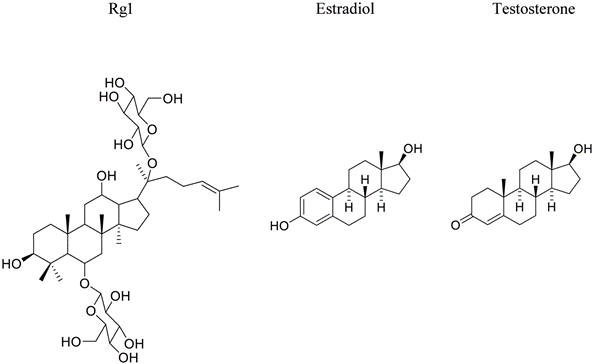
Some researchers believe Rg1 has relevance in longevity because the compound may influence cellular stress responses, reproductive function, cognition, and tissue repair. Hence, for their purposes, the Taiwan-based researchers aimed to uncover how supplementing with Rg1 affects physiological parameters related to muscle recovery and repair, like hormone levels, stem cells necessary for muscle repair, and mitochondrial abundance in muscle fibers following exercise in aged women.
Rg1 Increases Circulating Sex Hormones, Stem Cells in Muscle, and Muscle Mitochondria After Exercise
To evaluate Rg1’s effects on aspects of muscle repair following exercise, the scientists utilized female participants between the ages of 60 and 73. The women completed four sets of a seated leg press exercise. One hour before this bout of exercise, the women took 10 mg of Rg1. The women also had muscle samples taken three months before, immediately after, and 24 hours following the exercise bout for comparison.
To assess the effects of Rg1 on sex hormone levels following exercise, the researchers measured circulating estrogen and progesterone. They found that exercise without Rg1 supplementation reduced estrogen by 45%, but that Rg1 reversed this decline. Also, while exercise without Rg1 did not affect circulating progesterone, Rg1 supplementation doubled its levels. These findings suggest that Rg1 stabilizes estrogen levels, which decline with exercise alone, and that Rg1 significantly increases progesterone after a bout of exercise.
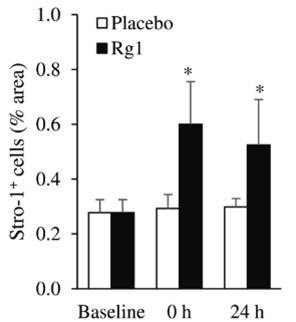
Because sex hormones like estrogen influence stem cells involved in muscle tissue repair, the scientists examined muscle stem cells derived from bone marrow within muscle tissue. More specifically, they sought to determine how Rg1 supplementation coupled with exercise affected the stem cells’ abundance. They found that Rg1 approximately doubled the abundance of these stem cells in muscle immediately after exercise and 24 hours after exercise, but had no effect without exercise. These findings suggest that coupling Rg1 with a bout of exercise significantly increases the number of stem cells involved in muscle tissue repair but that Rg1 without exercise has no such effect.
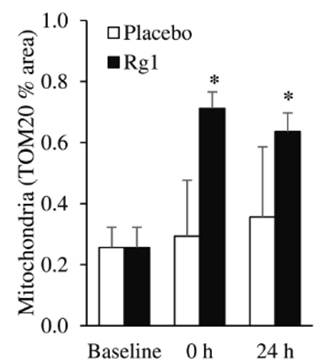
Mitochondria play a key role in muscle repair after exercise-induced muscle damage, in part, by supporting cell energy generation, so the researchers sought to determine how Rg1 affects mitochondrial abundance in muscle. They found that Rg1 approximately doubled the abundance of mitochondria in muscle immediately after exercise and 24 hours after exercise, but this effect did not occur without exercise. This finding suggests that coupling Rg1 supplementation with exercise may dramatically increase mitochondrial numbers in muscle, which could aid in muscle recovery and strength gains.
Interestingly, when examining the aforementioned bone marrow-derived stem cells under a microscope, the researchers found that they contained high concentrations of mitochondria. The researchers also found visual evidence that these stem cells fused with muscle fibers and donated mitochondria to muscles. This finding provides some of the first evidence in humans that stem cells from bone marrow donate mitochondria to exercise-damaged muscles. Moreover, Rg1 supplementation appears to significantly enhance this effect.
Identifying Ways to Boost Mitochondrial Abundance for Muscle Recovery and Enhanced Strength
This study from the Taiwanese group provides evidence that Rg1 enhances the abundance of bone marrow-derived stem cells in muscles for muscle regeneration after exercise in aged women. Furthermore, aged women often have low sex hormone levels, especially after a bout of exercise, and Rg1 stabilized these levels in circulation. Since sex hormones influence stem cells supporting muscle regeneration following exercise, this effect on sex hormone levels may, in part, drive the elevated abundance of stem cells in muscles.
Also, the group found visual evidence that the bone marrow-derived stem cells donated mitochondria to muscle fibers. Thus, the higher abundance of mitochondria-donating stem cells may have contributed to the increased abundance of mitochondria in muscles following Rg1 supplementation and exercise. In theory, Rg1 increasing muscle mitochondria in this way could potentially speed up recovery and enhance gains in muscle strength following exercise in aged women. However, human trials testing Rg1’s effects on recovery time and strength need to be conducted in the future for confirmation.
Altogether, the study’s findings supporting that bone marrow-derived stem cells donate mitochondria to muscle fibers and that Rg1 enhances this effect offer an exciting avenue for future research. Relatedly, stem cells are not the only cell type capable of carrying mitochondria and possibly donating them to muscles. In fact, different types of immune cells may perform a similar function, so future research should also investigate ways to harness mitochondrial transfer to muscles from other cell types.
Model: 11 sedentary women between the ages of 60 and 73
Dosage: One 10 mg oral Rg1 capsule taken one hour before resistance exercise
 Comments