


Latest Findings: Vesicles Delivering NMN-Synthesizing Enzyme Counteract Age-Related Liver Disease
Scientists show that exercise combats age-related metabolic dysfunction-associated liver disease in mice via microscopic vesicles containing eNAMPT (an NMN-synthesizing enzyme).
Highlights
- In a mouse model of an age-related liver disease, exercise alleviated a fatty liver, inflammation, a condition where cells do not respond effectively to insulin (insulin resistance), and liver scarring.
- As a primary mediator of these effects, scientists identified vesicles with high levels of eNAMPT circulating in exercised mice.
- These findings reveal a novel vesicle-mediated pathway by which exercise mitigates age-related liver disease and highlight the potential of eNAMPT-containing vesicles to mimic the effects of exercise in aging adults.
Aging is a major risk factor for the development of metabolic dysfunction-associated liver steatotic disease (MASLD), a liver disease affecting about 33% of adults over 70. Key features associated with MASLD include age-related metabolic decline, insulin resistance, and diminished cellular autophagy (a process in which cells break down and reuse damaged or worn-out components).
Aside from dietary and exercise regimens, interventions commonly used to counteract MASLD include certain medications. Yet, the medications currently used often target one or a few pathways associated with exercise, such as insulin sensitivity (with the medication pioglitazone), limiting their effects against MASLD.
Now, as published in Aging Cell, scientists from North China University of Science and Technology uncover that vesicles called exosomes derived from exercised mice simultaneously target inflammation, lipid metabolism, tissue scarring, and autophagy (all effects associated with exercise) in a mouse model of MASLD. Crucially, the researchers identified higher levels of eNAMPT (an NMN-synthesizing enzyme) in these exosomes. They also showed that the exosomes with elevated eNAMPT levels activate autophagy. These findings underscore the possibility of researchers developing eNAMPT-containing exosomes as therapies to target multiple pathways associated with exercising. Such therapies could counteract MASLD and potentially other conditions related to aging.
“Our study now positions exosomes as natural nanocarriers for eNAMPT, delivering this key enzyme to the aged liver to mitigate core pathological processes,” say the scientists in their publication.
More Information on Exosomes
Exosomes are tiny, membrane-bound particles released by cells that act as messengers between cells. They carry molecular cargo, such as RNA, DNA, or proteins, that facilitate communication. Once exosomes reach a target cell, the target cell can take them in, which can alter gene expression and cellular behavior. Moreover, exosomes and their molecular cargo play roles in many physiological processes, like immune signaling, tissue repair, and metabolic regulation.
Exercise Alleviates MASLD in Mice Fed a High-Fat Diet
To begin unraveling whether exosomes and their molecular cargo mediate exercise’s effects against MASLD in a mouse model, the Chinese scientists attempted to initiate MASLD in aged mice. To do so, they subjected the mice to a high-fat diet for up to eight months (roughly equivalent to about 35 years for humans). Moreover, while on a high-fat diet, the mice also engaged in an exercise regimen.
To find how the high-fat diet, along with the exercise regimen, affected the liver, the scientists examined liver tissue under a microscope. They found that the high-fat diet induced signs of liver inflammation and increased liver fat, aligning with the occurrence of MASLD. While exercise partially attenuated liver fat accumulation, it failed to fully restore the liver to its typical composition.
Collectively, these results demonstrate that a prolonged exposure to a high-fat diet in aged mice induced signs of liver inflammation and fat accumulation to model MASLD. Furthermore, while exercise attenuated the abnormal cellular composition of the liver in this model, it had limited efficacy in reversing cellular damage.
To evaluate aspects of the MASLD model’s metabolism, the scientists analyzed a marker of insulin sensitivity. They found that mice that consumed a high-fat diet without exercising exhibited less than half the levels of this marker, and that exercise alleviated this effect only after four months, but not eight months, of eating a high-fat diet. This finding suggests that MASLD is associated with impaired liver insulin sensitivity and that exercise does not restore it after long-term consumption of a high-fat diet.
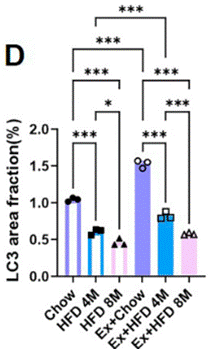
Impaired autophagy is strongly associated with MASLD and is considered one of the key mechanisms contributing to its development and progression. Thus, to assess exercise’s effects on impaired autophagy in the MASLD model, the researchers measured levels of LC3 (proteins seen in cells that indicate the formation of autophagosomes, the membrane structures used in autophagy). They found that the prolonged consumption of a high-fat diet more than cut LC3 levels in half. Exercise attenuated the reduction in LC3 after four months of exercise and consumption of a high-fat diet, but had no effect at eight months. This finding suggests that through its partial restoration of LC3 at four months, exercise restores autophagy to some degree in the MASLD mouse model, but not after prolonged consumption of a high-fat diet at eight months.
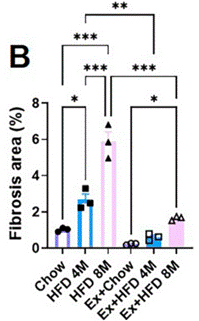
Liver fibrosis is the accumulation of tough, fibrous scar tissue in the liver caused by long-term inflammation. This condition is strongly associated with MASLD and is one of the key factors clinicians use to determine the severity of MASLD. Accordingly, the scientists evaluated the effects of exercise on liver fibrosis in the MASLD model.
The researchers found that long-term consumption of a high-fat diet significantly increased markers of liver fibrosis, yet exercise significantly attenuated this effect. This finding suggests that long-term high-fat diet consumption drives progressive liver fibrosis, but that exercise effectively disrupts this pathological process.
To elucidate exercise’s protective effects on the liver at the cellular level, the scientists investigated how exosomes contribute to exercise’s protective benefits. To do so, the researchers subjected mice to a single bout of exercise and isolated exosomes from their blood. Crucially, their analysis of proteins contained in the exosomes showed that those from exercised mice exhibited higher levels of eNAMPT.
Next, to test the effects of exosomes derived from exercised mice, the scientists utilized mouse liver cells. To model cellular stress due to fat accumulation in these cells (a defining feature of MASLD), the researchers treated the cells with sugar and fat. They found that the combination of these treatments significantly increased fat within the cells and that concurrently treating these cells with exosomes reduced fat accumulation. Co-treatment with a compound that inhibits SIRT1, an enzyme that drives autophagy, abolished this effect, suggesting that SIRT1 mediates the effects of exosome therapy.
Collectively, these findings support a model in which exosomes derived from exercised mice, enriched in eNAMPT, mitigate cellular stress from fat accumulation within cells by activating autophagy. This pathway could help explain exercise’s capabilities to mediate liver protection against age-related MASLD.
The Prospect of Applying eNAMPT Exosome Therapy to Humans
In humans, exosome therapy, involving the injection of a concentrated solution of exosomes, is an emerging regenerative treatment that is sometimes used to promote tissue repair and reduce inflammation. The most common applications of exosome therapy are for skin rejuvenation, hair restoration, and joint health.
This study suggests the possibility of developing a therapy that delivers elevated concentrations of eNAMPT within exosomes to counteract age-related MASLD and possibly other features of aging. eNAMPT is the principal enzyme in the synthesis of NMN, the precursor to NAD+. As such, administering eNAMPT-containing exosomes increases NAD+ levels. Since NAD+ is necessary for the activity of SIRT1, which positively regulates autophagy, this study supports the notion that using eNAMPT to increase NAD+ and activate SIRT1 enhances autophagy to rejuvenate cells.
In this study, the effects of exosomes containing elevated eNAMPT mediated exercise’s effects against MASLD in mice. Finding whether a newly developed exosome therapy with increased levels of eNAMPT mimics the effects of exercise and alleviates MASLD in humans will require human trials.
Also, exercise has beneficial effects against aging on all physiological systems in the body. Thus, mimicking some of exercise’s benefits against aging with exosomes that contain elevated eNAMPT levels may confer whole-body rejuvenation if effective in humans—a tantalizing prospect.
Model: 10-month-old C57BL/6J mice (roughly equivalent to 40-year-old humans) fed a high-fat diet until the age of 18 months (roughly equivalent to 56-year-old humans)
 Comments