


Latest Results: Blood NAD+ Levels May Track Heart Disease, Not Aging
A Nature Metabolism study links lower blood NAD levels to cardiovascular disease but finds no age-related decline in healthy adults, challenging the measure’s usefulness as a simple marker of aging.
Highlights
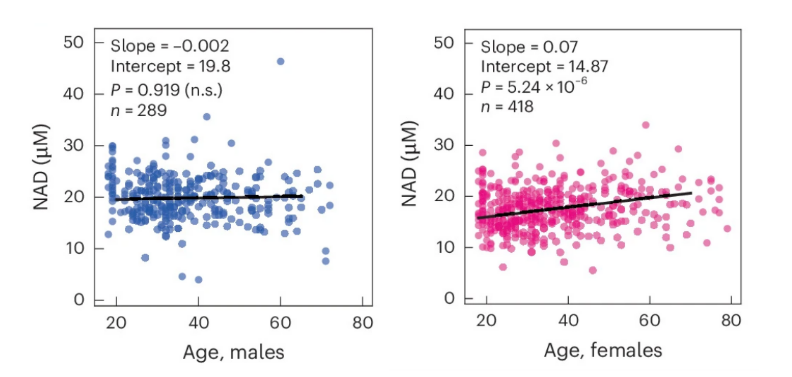
- Among healthy participants, blood NAD+ levels increased modestly with age in females but showed no significant age-related change in males.
- Participants with cardiovascular disease had lower blood NAD+ levels than healthy participants.
- The study focuses on NAD+ measured in blood, rather than establishing how NAD+ levels behave in other tissues.
Do NAD+ (nicotinamide adenine dinucleotide) levels fall as we age, or do they tell us more about our health? A study published in Nature Metabolism, from scientists at Vilnius University in Lithuania, found that whole-blood NAD+ levels were lower in people with cardiovascular disease but did not decline with chronological age in healthy adults. Instead, levels showed no significant association with age in healthy men and increased modestly with age in healthy women. The findings challenge the idea that falling blood NAD+ levels are an inevitable feature of aging and raise a more focused question: what can this measurement reveal about cardiovascular health?
Previous Research on Blood NAD+ Levels
NAD⁺ is a coenzyme essential for numerous biochemical reactions in the body, including those involved in cellular energy production and DNA repair. Accordingly, researchers have studied it widely in the biology of aging.
Along these lines, research suggests that NAD+ levels fall during aging in tissues like skeletal muscle, the brain, and skin. This research has led to a rapid growth in the use of supplements, like NMN (nicotinamide mononucleotide), that increase NAD+ levels to counteract age-related NAD+ decrements. Accordingly, the popularity of NAD+ precursor supplements that increase circulating NAD+ is based on the premise that age-related NAD+ depletion is a universal feature across tissues tied to aging.
Blood is the most accessible type of tissue for evaluating NAD+ levels and for measuring responses to NAD+ precursor supplementation. Nevertheless, the trajectory of NAD+ levels in blood remains controversial. Some studies report no age-related change in blood NAD+ levels, while others report a decline pertaining only to males. Still, other studies suggest a decline in both sexes. Most recently, it has been reported that blood NAD+ levels remain stable during aging. Due to these conflicting reports, and because of a lack of prior research helping to unravel how age-related diseases affect blood NAD+ levels in humans, the Lithuania-based researchers measured blood NAD+ levels in 1,068 adults, grouped into healthy participants and those with a chronic disease.
In Healthy Participants, Blood NAD+ Levels Remain Stable in Males and Modestly Increase in Females During Aging
To assess whether blood NAD+ levels change during aging, the researchers sampled blood in the morning, when the participants were in a fasted condition. This was meant to help them define age-associated, sex-associated, and disease-associated trajectories of blood NAD+ levels.
The researchers first partitioned study participants into a healthy group to evaluate the trajectory of blood NAD+ levels during aging in the absence of disease. They found that males exhibited significantly higher NAD+ than females across this group. Moreover, males showed no significant association between blood NAD+ and age, suggesting that their NAD+ levels remain, more or less, stable. Unexpectedly, and contrary to previous findings, blood NAD+ levels in females showed a significantly positive association with aging, indicating that NAD+ modestly increases during healthy aging in females. These results support that male blood NAD+ levels remain stable, while females’ levels modestly increase, during aging.
In Cardiovascular Disease, Blood NAD+ Levels Decline With Age in Males and Remain Stable With Age in Females
To evaluate how age-related diseases impact blood NAD+ levels, the researchers compared blood NAD+ levels of participants with chronic diseases to those of healthy participants. In males with a chronic disease, blood NAD+ was significantly reduced compared to healthy participants, while females with a chronic disease showed no age-related change (contrasting with the modest increase in blood NAD+ with age in healthy females). These findings suggest that blood NAD+ declines in males with a chronic disease and remains stable, rather than modestly increasing, in females with a chronic disease.
To unravel which age-associated diseases were most significantly associated with reduced blood NAD+, the researchers performed statistical analyses in which they grouped participants based on the category of chronic disease they had. They primarily assessed types of cardiovascular diseases, such as high blood pressure and abnormal levels of lipids in the blood. They could not assess whether other chronic conditions, such as diabetes, cancer, and immune-mediated inflammatory disease, were associated with reduced blood NAD+, because too few participants had these conditions for a meaningful statistical analysis.
They found that blood NAD+ was significantly reduced in participants with cardiovascular disease compared to healthy participants. This was especially the case for participants with high blood pressure. These results suggest that lower NAD+ levels may help track cardiovascular disease, and that they may not serve as a simple marker of aging.
“Our data do not provide evidence for a universal whole-blood NAD+ deficit in healthy adults and therefore provide no broad rationale for NAD+-boosting interventions,” say the researchers in their publication.
What Blood NAD+ Levels Can and Cannot Tell Us About Aging
Taken together, these findings challenge a simple narrative: that NAD+ inevitably declines throughout the body as people grow older. In healthy adults, blood NAD+ showed no significant age-related decline in males and increased modestly with age in females. Lower levels were instead associated with cardiovascular disease, particularly high blood pressure. This suggests that interpreting blood NAD+ levels requires attention to cardiovascular health status and sex, rather than the number of years lived.
Importantly, the results do not establish that reduced NAD+ causes cardiovascular disease or that raising it would prevent or treat the condition. The main analysis compared different people at a single time point, rather than tracking disease development over time. Participants with chronic diseases were also taking medications, leaving open the possibility that treatment contributed to the observed differences. Reduced blood NAD+ levels therefore remain a research finding associated with cardiovascular health, not an established diagnostic test or treatment target.
The measurement itself also deserves clarification. The researchers assessed total NAD+—the combined amount of NAD+ and NADH (an NAD+ molecule with an added hydrogen atom)—not NAD+ alone. Moreover, a blood measurement cannot establish what is happening in muscle, the brain, or other tissues. These findings therefore do not rule out tissue-specific changes in NAD+ levels during aging; they show why blood measurements should not be treated as a stand-in for NAD+ level status throughout the body.
For NAD+-boosting supplements, the distinction between increasing a blood measurement and improving health is crucial. This study does not establish a universal age-related blood NAD+ deficit in healthy adults, nor does it demonstrate that supplementation prevents cardiovascular disease or slows aging. Future research will need to determine whether lower blood NAD+ levels precede disease, reflect its consequences, or relate to treatment, and whether changing NAD+ levels produces meaningful clinical benefits. For now, the study supports a more nuanced view: blood NAD+ levels may reflect aspects of health, but they are not a simple gauge of how much someone has aged.
Model: 1,068 adults over the age of 18
 Comments