


New Harvard Study: AI Estimates Rate of Aging with Facial Photos
Harvard researchers use FaceAge (an AI algorithm that predicts biological age from facial photographs) to measure increased aging rates associated with lower survival in patients with cancer.
Highlights
- Harvard scientists used FaceAge to estimate the rate of aging.
- Cancer patients with higher estimated rates of aging had a significantly increased likelihood of death.
- These significant findings underscore the possibility of using FaceAge to estimate the rate of aging in cancer patients and healthy aging adults.
Chronological age (our age according to calendar years) has long been recognized as a predictor of how long someone has left to live, especially in patients with cancer. However, chronological age largely ignores variation in the rate of biological aging (a measure of how quickly cells, tissues, and organs degenerate).
Accordingly, measuring variations in the rate of biological aging could serve as an important indicator of someone’s likelihood of survival. For this reason, it is becoming increasingly important to explore ways of measuring rates of biological aging, especially those based on easily accessible indicators, such as facial features.
In line with this notion, scientists at Harvard University published results in Nature Communications showing that measuring the rate of facial aging across timespans of up to four years serves as a way to help predict survival in cancer patients. In that regard, higher rates of facial aging were associated with worse overall survival.
Assessing the rate of aging with facial photographs could serve as a new, non-invasive technique to predict the likelihood of survival in cancer patients or healthy aging adults. Clinicians could use the rate of facial aging to quickly administer medical care to people with a high rate of aging in an attempt to possibly slow their aging and prevent death, whether they have cancer or other age-associated conditions. Also, scientists could use this easily accessible way to measure the rate of aging to test whether interventions designed to slow aging work.
“Our study introduces [Face Aging Rate] as a non-invasive prognostic marker for cancer survival outcomes,” say the Harvard researchers in their publication. “By analyzing serial facial photographs of 2276 cancer patients undergoing radiation therapy, we have demonstrated that accelerated facial aging, quantified by [Face Aging Rate], is significantly associated with decreased survival probability across different time frames.”
How Facial Features May Signify Biological Age
Previous research has shown that AI can predict the age of faces at a single time point with FaceAge (an AI algorithm that predicts biological age from facial photographs). This same research has shown that an older appearance than chronological age is associated with worse survival outcomes. Such research supports the notion that researchers can use facial aging, involving skin texture alterations, loss of facial volume, and changes in bone structure, to quantify biological age.
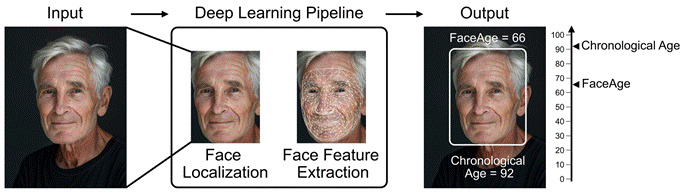
In their study, the Harvard scientists added a crucial facet to assessing biological age—estimating the rate of biological aging over extended durations. According to their publication, using two measurements of FaceAge at different time points to assess the rate of aging provides superior insights into the aging process than a single FaceAge estimate.
Using Facial Photographs at Two Time Points to Assess Accelerated or Decelerated Aging
To measure the rate of facial aging, the researchers utilized FaceAge at two time points during cancer radiation therapy treatments. The scientists subtracted the FaceAge score of the facial photograph taken at the first time point from that of the second time point and divided the resulting value by the time interval between the two facial photographs (up to four years in this study). After completing this calculation, the resulting value reflected a rate of facial aging, referred to as the Face Aging Rate (FAR). FAR values above one represent accelerated aging, whereas those less than one represent decelerated aging.
To evaluate whether using FaceAge at two time points to calculate FAR values yields meaningful assessments of biological age, the Harvard scientists analyzed the two FaceAge scores from the cancer patients. Cancer patients with FAR values above 1 (denoting accelerated aging) exhibited significantly lower survival compared to those with FAR values equal to or below 1 (reflecting decelerated aging). These findings provide evidence that the use of FaceAge across time points to calculate FAR yields meaningful data, as higher FAR values were associated with an increased risk of mortality. These results also align with previous research showing that accelerated biological aging is associated with increased mortality.
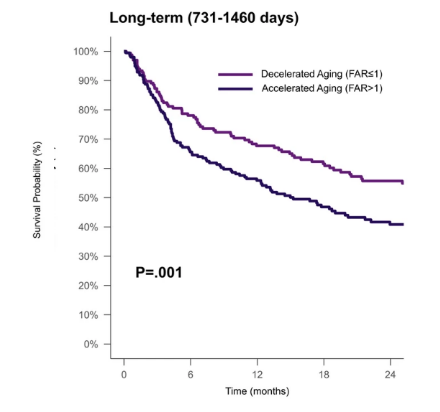
The Harvard researchers also ran further statistical analyses to compare FAR’s capability to estimate the likelihood of survival against FaceAge measurements at single time points. They found that FAR produced more statistically robust predictions of survival when compared to single FaceAge calculations. These data support the idea that using FaceAge to calculate FAR serves as an advancement in using facial aging patterns to estimate survival compared to FaceAge calculations at single time points.
“Our findings build upon previous work in biological age indicators by examining the changes in facial appearance over time,” say the Harvard scientists in their publication.
Facial Photographs as a Means to Measure Biological Age
This study provides evidence that using AI to estimate biological age with facial photographs taken at two time points can add precision to the FaceAge analytical technique. Along these lines, applying other techniques to evaluate biological age, such as DNA molecular tagging pattern-based methods (epigenetic clocks), could also incorporate serial measurements at more than one time point to calculate biological aging rates. Using serial measurements of biological age could aid in unraveling whether aging occurs faster at certain life stages than others and whether applying aging intervention therapeutics slows any accelerations in the pace of aging.
This particular study was done in cancer patients, a population that research has shown has a higher propensity to exhibit accelerated aging. Future studies using FaceAge to measure FAR could perform a similar assessment in healthy aging adults to confirm that FAR predicts the likelihood of survival in populations without cancer. Once confirmed, clinicians could potentially use FAR in otherwise healthy aging adults to gauge whether any undetected physiological factors, such as a vitamin deficiency, may be contributing to accelerated aging.
Importantly, the development of FaceAge and its enhanced precision in predicting survival with FAR calculations positions using facial photographs as a potentially impactful way to assess the rate of biological aging. The ease with which researchers and clinicians can acquire facial photographs across multiple time points makes this method of assessing biological age a potentially cutting-edge way to measure aging rates in humans across different stages of the human lifespan. As such, this technique could help unravel patterns of the process of aging that have yet to be discovered.
 Comments