


NMN Activates Sirtuins to Combat Cardiovascular Aging, New Study Shows
The NAD+ (nicotinamide adenine dinucleotide) precursor NMN (nicotinamide mononucleotide) mitigates aneurysm development in mice and fuels the age-associated enzyme sirtuin-7.
Highlights
- NMN prevents the development of aneurysms in mice, which reduces the incidence of ruptures and increases the chances of survival.
- The abundance of an enzyme called sirtuin-7, which is activated by NMN, is low in middle-aged and older adults with aneurysms.
- The results suggest that activating sirtuin-7 with NMN may prevent the development of aneurysms in older adults.
The largest artery in the body, the aorta, projects from the heart, takes a quick turn, and descends into the abdomen. As the wear and tear of aging takes its toll, the abdominal portion of the aorta collects unavoidable damage. Eventually, a balloon-like bulge known as an abdominal aortic aneurysm (AAA) can develop. Most individuals with an AAA report no symptoms, yet its rupture triggers a catastrophic, often fatal, level of internal bleeding.
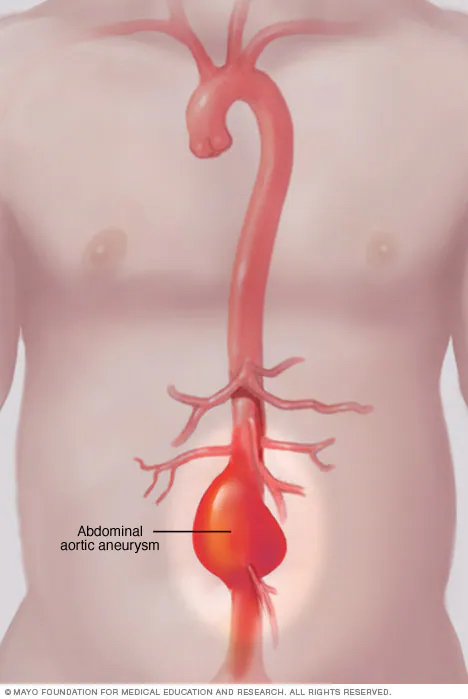
Compounds that effectively prevent or delay AAA are lacking, prompting researchers from Central South University in China to investigate NMN. In a new study published in Experimental & Molecular Medicine, they show that NMN reduces the development of AAAs in mice. NMN also increases the survival of these mice. Moreover, the researchers provide evidence that NMN may reap beneficial effects against AAAs in older adults.
NMN Prevents Mouse AAA Development
Besides advanced age, high blood pressure and atherosclerosis (artery plaque buildup) increase the risk of developing AAA. With this in mind, the Chinese researchers induced high blood pressure in genetically modified mice. The mice lacked a gene called ApoE, which makes the apoE (apolipoprotein E) protein. The apoE protein helps clear cholesterol and fats from the bloodstream, but without it, mice develop atherosclerosis.
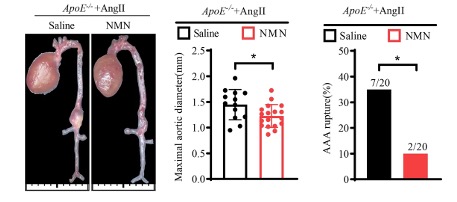
By giving mice that lack apoE (ApoE-/-) a compound called angiotensin II to induce high blood pressure, the researchers generated a model for AAA. It took 28 days of angiotensin II exposure for the AAAs to develop, and rupturing occurred in 35% of the mice. To determine the effect of NMN, the researchers surgically implanted pumps into the mice that steadily released NMN. Remarkably, NMN reduced AAA size and the number of ruptures, while also increasing the survival of the AAA model mice.
Low Sirtuin-7 in Human AAA Tissue
Enzymes called HDACs (histone deacetylases) were previously implicated in the pathology of AAA and other cardiovascular diseases. As the name suggests, HDACs interact with histones, which are spool-like proteins usually wrapped in DNA. Deacetylation, the opposite of acetylation, is the process of removing chemical attachments called acetyl groups from proteins. In general, histone deacetylation—removing acetyl groups from histones—causes DNA to wrap around the histones more tightly, blocking the activation of certain genes.
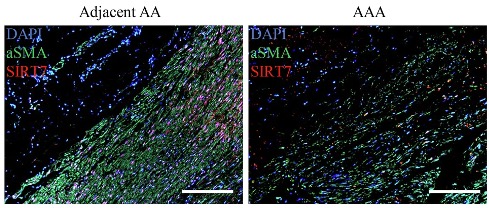
To determine which HDACs are most involved in AAAs, the researchers examined aortic tissue taken from AAA patients undergoing surgery. The AAA tissue was compared to healthy aortic tissue, also taken from the individuals undergoing surgery. The researchers then measured the abundance of 18 different HDACs. They found that sirtuin-7 had the lowest levels of any other HDAC in AAA tissue. Sirtuin-7, one of the seven sirtuin enzymes, is involved in DNA repair and maintenance.
Low Sirtuin-7 Contributes to AAA Development
To explore the effects of low sirtuin-7 levels, the researchers genetically removed the sirtuin-7 gene (Sirt7) from AAA mice. The researchers found that these mice were more likely to develop AAAs and die of ruptures, suggesting that low sirtuin-7 levels help drive AAA. The researchers also increased sirtuin-7 levels in AAA model mice using gene therapy. They found that increasing sirtuin-7 led to a decrease in AAA development, ruptures, and mortality, suggesting that high sirtuin-7 levels can mitigate AAA development.
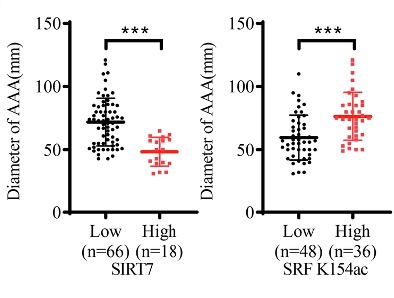
Since HDACs like sirtuin-7 can deacetylate proteins other than histones, the researchers investigated which proteins sirtuin-7 deacetylates. They found that it deacetylates a protein called SRF (serum response factor), which controls the activation of hundreds of genes. Moreover, in AAA patients, larger AAAs were correlated with lower sirtuin-7 levels and higher levels of acetyl groups attached to SRF. These findings suggest that low sirtuin-7 levels contribute to AAA development by keeping SRF acetylated.
Working Model for How Low Sirtuin-7 Levels May Contribute to AAA
The researchers went on to model how low sirtuin-7 levels contribute to AAA: Without sirtuin-7, SRF remains acetylated, which causes it to move out of the nucleus and into the cytoplasm. In the cytoplasm, SRF is degraded and cannot control any genes. In contrast, when sirtuin-7 is active, it deacetylates SRF and stops SRF from moving into the cytoplasm for degradation. SRF controls the contractile genes that make contractile proteins, which form highly structured filaments within muscle cells.
Our blood vessel walls contain a thin layer of muscle cells known as vascular smooth muscle cells (VSMCs). When our blood vessels are injured, such as by inflammation, VSMCs undergo a transformation that promotes cardiovascular disease. One of the key features of this transformation is the loss of contractile filaments. These contractile filaments allow VSMCs to contract and modulate the flow of blood. Without the contractile machinery, the transformed VSMCs begin to duplicate and divide, supporting the development of cardiovascular diseases like atherosclerosis and AAA.
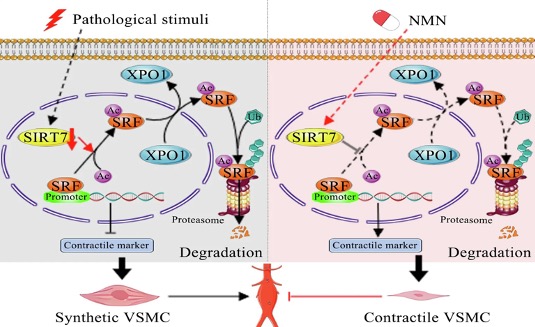
Taking NMN to Fuel Sirtuins and Combat Cardiovascular Complications
The findings of the Central South University researchers suggest that low sirtuin-7 levels contribute to the pathology of AAA. Sirtuin-7, an NAD+ (nicotinamide adenine dinucleotide)-dependent deacetylase, relies on NAD+ to deacetylate proteins. It follows that boosting the essential molecule NAD+ could compensate for reduced sirtuin-7 levels by increasing its deacetylase activity.
Studies on Boosting NAD+ to Mitigate AAA
Nevertheless, the researchers did not measure NAD+ levels to determine if they were low in AAA tissue. A previous study, however, showed that NAD+ levels were low in an AAA mouse model. The previous study also showed that the NAD+ precursors niacin and nicotinamide each restored NAD+ levels, activated a sirtuin called sirtuin-1, and protected against the development of AAA. Additionally, another NAD+ booster, NR (nicotinamide riboside), has been shown to combat AAA development, ruptures, and sudden death.
In 2016, there was a study very similar to this Central South University study, whereby low sirtuin-1 levels were observed in AAA tissue from patients undergoing surgery. This means that boosting NAD+ could potentially combat AAAs by activating multiple sirtuins, including sirtuin-1 and sirtuin-7.
Studies on Low NAD+ Levels in AAA
Furthermore, the main enzyme that synthesizes NAD+, NAMPT (nicotinamide phosphoribosyltransferase), has been shown to decline with age in VSMCs. In AAA patient and AAA model rodent tissues, a molecule called CTRP13, which activates NAMPT, was shown to be reduced. Moreover, treating AAA model mice with CTRP13 reduced AAA development unless NAMPT was genetically removed. This study supports the idea that low NAD+ levels contribute to AAA development.
In a more recent study, low NAMPT and NAD+ levels were observed in human AAA tissue, along with mitochondrial dysfunction. NAD+ not only fuels sirtuins but also improves mitochondrial function, which could help to combat AAAs. In the genetic form of aortic aneurysm, which usually occurs closer to the heart, reduced NAMPT levels were also observed. What’s more, lower NAMPT levels were correlated with larger aortic aneurysms.
Who Would Benefit the Most from Boosting NAD+?
Together, these studies suggest that when NAD+ levels are low within VSMCs, aortic aneurysms are more likely to develop. We can then deduce that replenishing NAD+, with NMN or other NAD+-boosting interventions, may play a preventative role in the development of aortic aneurysms. Those at higher risk for AAAs may benefit the most from NAD+, particularly males who smoke, have high blood pressure, have signs of atherosclerosis like high LDL cholesterol, and are of advanced age.
Model: Mice lacking the apoE gene (ApoE−/−) exposed to angiotensin II to model an abdominal aortic aneurysm.
Dosage: 500 mg/kg of NMN every other day administered through surgically implanted pumps for 28 days
 Comments