


Panax Ginseng Compound May Help Prevent Age-Related Muscle Loss (Sarcopenia)
The compound ginsenoside Ro, found in the Panax ginseng root, effectively increased muscle mass and enhanced physical endurance in a mouse model of age-related sarcopenia.
Highlights
- In laboratory dishes, ginsenoside Ro reduced muscle cell senescence (a state where cells stop dividing yet remain metabolically active).
- In a mouse model of age-associated sarcopenia, ginsenoside Ro increased muscle mass and enhanced physical endurance.
- Additionally, ginsenoside Ro restored cellular energy production in muscles.
Sarcopenia, a disorder strongly correlated with aging, is characterized by a progressive, gradual decline in muscle mass and strength. Some research suggests that sarcopenia affects upwards of 23% of adults over 70 globally. Hence, with a global acceleration in the growth of the population of aging adults, sarcopenia has become a major public health issue that may worsen in the future.
The primary treatment recommendations for sarcopenia are resistance training and adequate protein intake. However, currently, no pharmacological agents specifically targeting sarcopenia have received approval for application.
Now, as published in Phytomedicine, scientists from Hangzhou Medical College Affiliated People’s Hospital in China have unveiled results showing that ginsenoside Ro, a compound found in Panax ginseng supplements, alleviated aspects of sarcopenia in muscle cells and a sarcopenia mouse model. More specifically, ginsenoside Ro reduced muscle cell senescence (a state where cells become dysfunctional and stop dividing) in a laboratory dish. Moreover, ginsenoside Ro attenuated physical parameters associated with sarcopenia, like the loss of muscle mass and impaired physical endurance. These findings underscore the potential of supplements containing ginsenoside Ro in maintaining muscle function in the elderly.
Background Information on Ginsenoside Ro
Ginsenoside Ro is a compound found in Panax ginseng, a plant with a root used in dietary supplements. Furthermore, Panax ginseng has been under investigation for positive effects on cellular energy, lowering stress, improving cognition, and enhancing immune function, yet many of its uses have not been strongly proven.
About 0.226% of the Panax ginseng root is composed of ginsenoside Ro, making this compound relatively abundant, although not as abundant as other compounds of the ginsenoside class, such as Rb1 and Rg1. Collectively, the capabilities of compounds in the ginsenosides class to mitigate sarcopenia have remained, in large part, unexplored. However, because of evidence suggesting ginsenosides have anti-inflammatory and potential aging intervention effects, the China-based researchers chose to screen an array of ginsenosides for effects against sarcopenia.
Ginsenoside Ro Reduces Muscle Cell Senescence, Increases Muscle Mass, and Enhances Physical Endurance in a Model of Sarcopenia
To this end, the scientists selected 19 common ginsenosides and used a statistical analysis to predict what cellular proteins these ginsenosides bind to. They identified over 4,000 proteins related to aging and sarcopenia to which the ginsenosides bind.
Further experimentation at the molecular level confirmed strong binding of the ginsenosides to key aging-related target proteins, such as AKT1 (a protein involved in cell metabolism and survival). Among the ginsenosides tested in this experiment that measured binding capabilities, ginsenoside Ro exhibited the highest binding stability. Along these lines, a higher binding stability suggests a stronger interaction with the proteins related to aging that the researchers assessed in this experiment. For this reason, the researchers selected ginsenoside Ro among the ginsenosides tested for further experimentation in muscle cells and a mouse model of sarcopenia.
To model age-related sarcopenia in mouse muscle cells, the researchers treated the muscle cells with D-galactose, a sugar found in foods like milk and honey that becomes toxic to cells in excessive amounts. The researchers found that treating muscle cells with D-galactose significantly reduced their survival by about 55%, yet ginsenoside Ro treatment significantly restored cell survival. These data suggest that ginsenoside Ro enhances muscle cell survival in a muscle cell aging model.
Muscle cell senescence has been strongly associated with sarcopenia, and, in fact, older mice and humans show an elevated expression of protein markers of senescence in muscle cells. For this reason, the scientists tested the effects of ginsenoside Ro on cellular senescence in the model of muscle cell aging. They found that D-galactose treatment significantly increased the abundance of senescent muscle cells, but that adding ginsenoside Ro to the cells considerably decreased senescent cell abundance. Accordingly, the area of senescent muscle cells decreased by 6.94% when the researchers added ginsenoside Ro to the D-galactose treatment. This finding suggests that ginsenoside Ro reduces senescent cell abundance to protect against muscle aging.
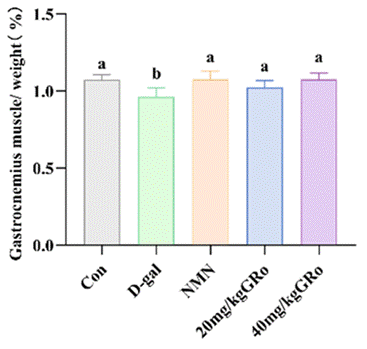
Due to the data suggesting ginsenoside Ro protects muscle cells against aging, the China-based researchers next tested whether ginsenoside Ro can counteract age-related sarcopenia in mice. To do so, they injected mice with D-galactose to induce age-related sarcopenia, since D-galactose treatment is a well-established model of accelerated aging in mice and can induce some sarcopenia-like features.
With their mouse model of accelerated aging with sarcopenia-like features, the researchers sought to test whether ginsenoside Ro could attenuate physical signs of sarcopenia, specifically, reduced muscle mass. Indeed, they found that when they measured the mass of a leg muscle, ginsenoside Ro significantly increased the mass of this muscle in the mouse model. Interestingly, treatment with the nicotinamide adenine dinucleotide (NAD+) precursor, nicotinamide mononucleotide (NMN), had a similar effect. This finding suggests that ginsenoside Ro and NMN significantly attenuate the effects of age-related sarcopenia on reduced muscle mass.
To then evaluate whether this effect on muscle mass influences exercise capacity, the researchers assessed whether ginsenoside Ro improves speed and endurance in the mice. With an experiment that tested how far and how fast the mice could run on a treadmill, they found that ginsenoside Ro partially restored running distance and maximum speed. These results suggest that, in addition to partially restoring muscle mass, ginsenoside Ro partially restores exercise capacity.
Also, because impaired production of cellular energy in the form of ATP molecules can lead to muscle fatigue, the scientists sought to determine whether ginsenoside Ro restores muscle ATP levels in the sarcopenia model. They found that, while D-galactose injections significantly decreased ATP levels in the mice’s muscles, ginsenoside Ro partially restored ATP content. This finding suggests that ginsenoside Ro improves muscle energy metabolism by restoring muscle ATP production in sarcopenia.
“[Ginsenoside Ro] shows promise as a functional food or dietary supplement for maintaining muscle health in the elderly,” say the China-based scientists in their publication.
Optimizing the Ginsenoside Ro Content in Panax Ginseng Supplements
Based on this study’s findings, ginsenoside Ro may serve as an agent that counteracts age-related sarcopenia. Only future clinical trials that test ginsenoside Ro in patients with sarcopenia can confirm this.
For aging adults who want to hedge their bet on the preclinical findings from the sarcopenia mouse model in this study, pure ginsenoside Ro supplements for direct consumer sale do not currently exist. However, to obtain ginsenoside Ro, consumers can take Panax ginseng supplements, which typically cost between $12 and $30 for a month’s supply.
Moreover, the age of the Panax ginseng root from which the supplements come can have an effect on how much ginsenoside Ro the supplement contains. For example, a six-year-old ginseng root contains 4.228 mg/g of ginsenoside Ro, compared to 0.445 mg/g in a two-year-old root. Thus, for anyone interested in supplementing with Panax ginseng, if finding out the age of the root for supplementation is possible, older roots appear to contain higher quantities of ginsenoside Ro.
Model: Four-week-old C57BL/6N mice
Dosage: Injections of 200 mg/kg of D-galactose, as well as oral treatments of 20 mg/kg or 40 mg/kg of ginsenoside Ro for 10 weeks
 Comments