


Reversing The Silent Driver of Aging with Pigment Supplement: New Clinical Trial
Insulin resistance—the silent driver of aging not measured during routine medical check-ups—is countered by supplementation with plant-based pigments called anthocyanins.
Highlights
- Signs of insulin resistance were reversed or reduced by anthocyanin supplementation in middle-aged and older adults.
- In the skin, anthocyanin supplementation reduced the toxic accumulation of molecules that promote insulin resistance.
Insulin resistance (IR) has been called the Eminence Grise—the unseen but powerful driver—of aging. It underlies a plethora of age-related conditions, including type 2 diabetes, heart disease, cognitive impairment, and liver disease. However, in a recent study, researchers from Wuhan University in China showed that IR can be countered by anthocyanins, the pigments responsible for the deep red, blue, and purple colors seen in fruits and vegetables.
Measuring Insulin Resistance
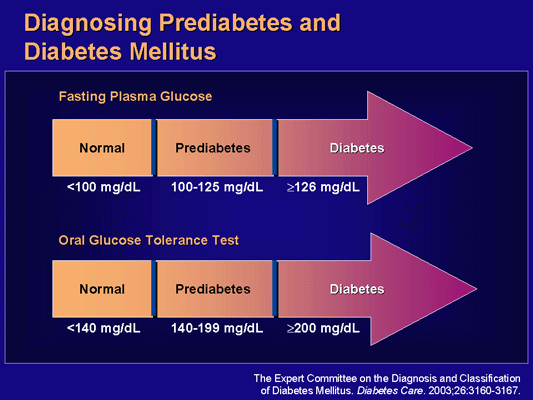
IR is the inability of cells to respond to insulin and clear glucose from the bloodstream. In its initial stages, IR does not cause abnormally high fasting blood glucose levels. It can linger and take years before IR progresses to prediabetes, where blood glucose levels are measurably high. If unresolved, prediabetes develops into full-fledged type 2 diabetes, where blood glucose levels are equal to or above 126 mg/dL.
Since fasting blood glucose levels are not elevated during the early stages of IR, this age-driving metabolic condition can go undetected. This is because routine medical check-ups do not include measurements like the oral glucose tolerance test (OGTT), which more robustly assesses IR than fasting plasma glucose. For the OGTT, patients ingest a large amount of glucose, which is followed by blood glucose measurements, usually hours later. Normally, blood glucose levels return to normal a few hours after ingestion, but with IR, they remain elevated—a condition called impaired glucose tolerance (IGT).
Anthocyanins Counter Insulin Resistance
Multiple epidemiological studies have linked low anthocyanin intake with IR. However, likely due to participant selection, the results from randomized controlled trials (RCTs) have been mixed. These previous RCTs included participants with varying levels of metabolic dysfunction, which could skew the results. To address this in their RCT, the Wuhan researchers specifically selected participants with IGT.
The participants were randomly selected to receive either 160 mg of anthocyanins or a placebo for 12 weeks. After 12 weeks, about 56% of participants in the anthocyanin group exhibited a reversal of IGT, while only 30% of the placebo group did. Additionally, to obtain a better assessment of IR, the researchers turned to the Matsuda index, which incorporates blood glucose and insulin levels to determine IR. As gleaned from the reversal of IGT, the Matsuda index was significantly higher in the anthocyanin group, suggesting a reduction in IR.
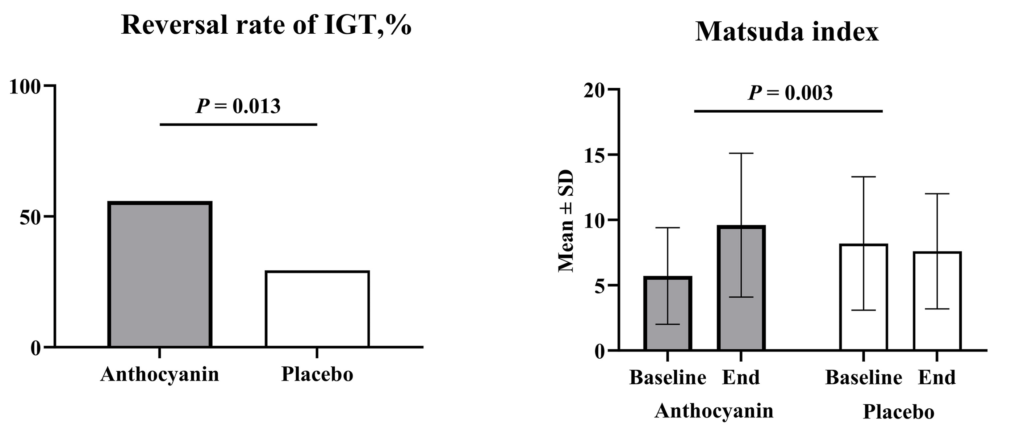
Notably, the researchers also assessed the participants’ β-cells—the pancreas cells that secrete insulin. With IR, β-cells usually secrete more insulin than usual to help clear glucose from the bloodstream. While the researchers did not observe improved β-cell function, other assessments revealed that insulin signaling was improved in the anthocyanin group. Together, these findings suggest that anthocyanin supplementation improves insulin signaling and blood glucose clearance in people with early IR.
Anthocyanins Mitigate Skin Aging
What do we have in common with cake and steak? The brown crust formed on baked goods and the sear we see on a steak are a result of the Maillard reaction—a chemical reaction that occurs when sugars bind to proteins and other macromolecules. This reaction leads to the formation of AGEs (advanced glycation end products), which are delicious on cake and steak. However, AGEs are not so delicious when they form in our bodies, leading to disruptions in cellular function that promote aging.
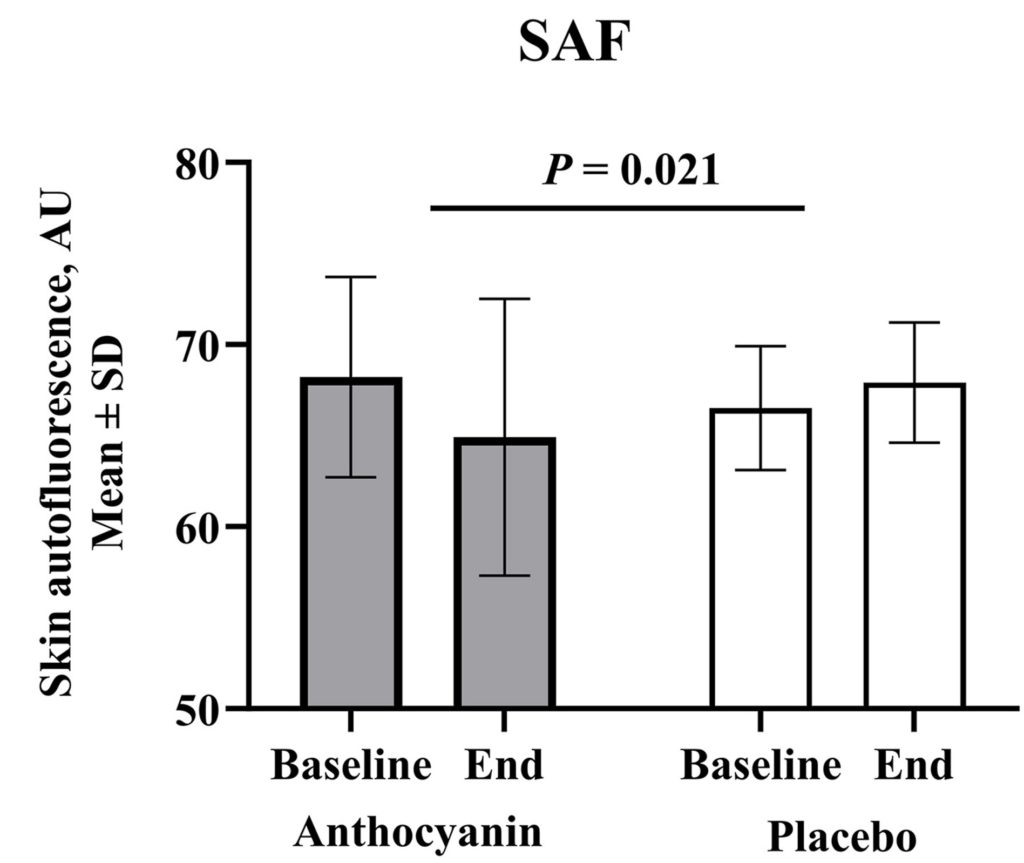
AGEs directly interact with insulin and its receptors, which disrupts insulin signaling and leads to insulin resistance. Moreover, AGEs can interact with collagen in the skin, promoting wrinkles and other aspects of skin aging. Interestingly, the type of AGEs found in the skin emit fluorescent light that can be easily measured. With this in mind, the Wuhan scientists examined and found that the anthocyanin group exhibited less skin AGEs than the placebo group. These findings point to the ability of anthocyanins to reduce AGEs in the skin and potentially the insulin signaling machinery.
Reversing Signs of Insulin Resistance
The results of the Wuhan researchers’ RCT suggest that supplementing with anthocyanins can reverse signs of IR, such as IGT. Based on mixed results from previous RCTs, these findings may also suggest that anthocyanins are only effective during the early stages of disrupted insulin signaling. With IR, cells don’t respond properly to insulin, and to compensate, β-cells secrete more insulin. Over time and with age, the constant overworking of β-cells leads to β-cell deterioration, which the researchers showed was not reversed by anthocyanins. It follows that anthocyanins may play a preventive role against prediabetes, type 2 diabetes, and the ensuing conditions linked to type 2 diabetes, such as dementia, heart disease, and cancer.
With that being said, supplementing with anthocyanins is by no means the only way to potentially prevent or reverse early IR. AGEs contribute to the development of IR by binding to critical proteins like insulin and insulin receptors. Thus, avoiding animal-based foods like meat, especially when cooked to promote the Maillard reaction, can reduce the accumulation of AGEs in the body. High sugar intake, particularly of added sugars, also promotes IR, so avoiding processed foods may also be beneficial. Additionally, as nature’s medicine, regular exercise also mitigates IR.
As it were, our cells need glucose to generate cellular energy and function normally. IR stops glucose from efficiently entering cells, particularly in highly metabolically active organs, such as the liver, muscle, and fat tissue. IR also affects organs like the brain, whereby Alzheimer’s disease has been called type 3 diabetes. Considering that IR deprives our cells of the energy necessary to function and survive, it may be easy to see why IR has been called the Eminence Grise of aging.
 Comments