


Scientists Identify a New Natural Senolytic that Counters Physical Aging
Japanese scientists identify Rhodiola rosea as a senolytic, which improves the physical capacity of middle-aged mice and reduces hair loss, hair graying, and skin decline in aged mice.
Highlights
- Rhodiola rosea ingestion improves the metabolic health of obese mice.
- The plant root extract improves the physical capacity of middle-aged mice.
- Rhodiola rosea alleviates signs of aging in older mice, including hair loss and graying.
Our cells face constant insults, including DNA damage and metabolic stress. As these accumulate and pass a critical threshold, a transformation occurs. Cells that were once functional and cooperative become dysfunctional and harmful. These senescent cells are linked to a range of chronic conditions, including cardiovascular, metabolic, and neurodegenerative diseases that limit lifespan.
Although a healthy immune system can clear senescent cells, its potency declines with age, allowing these cells to accumulate. Senolytics—compounds that selectively eliminate senescent cells, without harming healthy ones—offer a promising alternative. However, some pharmaceutical senolytics, such as dasatinib, may cause adverse effects, prompting interest in safer, naturally derived options.
In a new study published in iScience, researchers from Juntendo University in Japan identified Rhodiola rosea (Rosea) as a senolytic. They went on to demonstrate that Rosea improves the metabolic health of obese mice and the physical capacity of middle-aged mice. Moreover, they found that Rosea counters hair graying, hair loss, skin decline, and sleep-cycle disturbances in aged mice. These findings reveal that Rosea may alleviate certain aspects of aging by eliminating senescent cells.
Rosea Improves the Metabolic Health of Obese Mice
To identify a new natural senolytic, the Juntendo University researchers screened 481 plant-derived compounds. In testing which compound could eliminate the most senescent cells without harming normal ones, they landed on Rosea. They then tested the effects of Rosea on various mouse models of metabolic disease and aging, which are often linked.
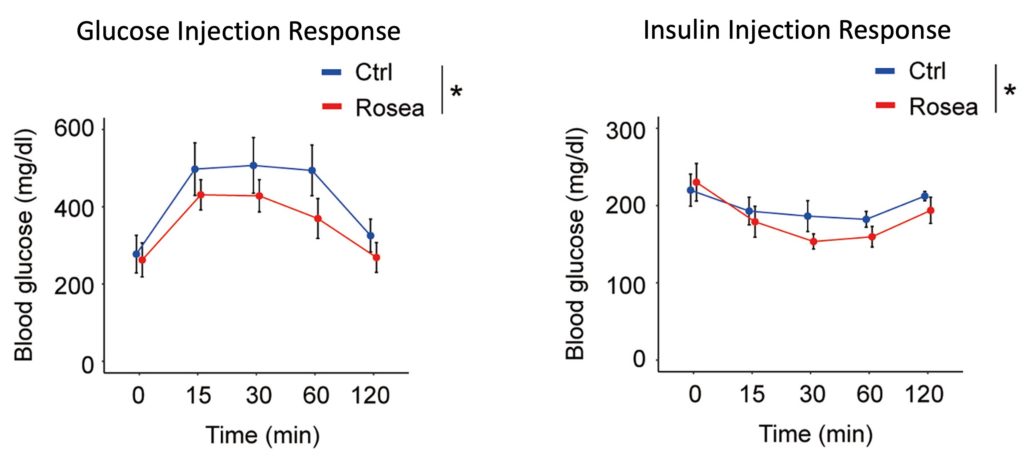
Along those lines, overeating-induced metabolic stress can drive senescent cell accumulation in fat tissue and accelerate the aging process. As such, the researchers tested the effects of Rosea on obese mice. Rosea reduced fat tissue senescence and inflammation without affecting food intake, body weight, or fat mass. It also improved blood glucose clearance in response to glucose and insulin injections, consistent with greater insulin sensitivity, a vital marker of metabolic health.
Rosea Improves the Physical Capacity of Middle-Aged Mice
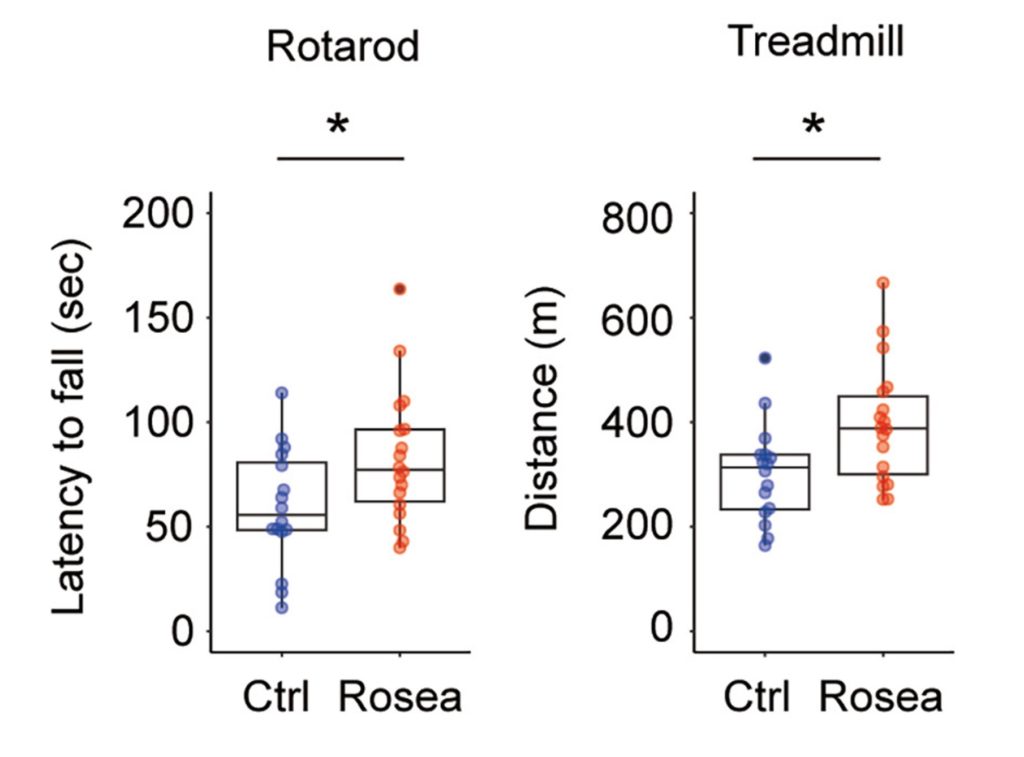
Considering that senescent cells accumulate spontaneously with advancing age, the Juntendo researchers tested Rosea on middle-aged mice. Rosea increased the time the mice could balance on a rotating rod (rotarod) and the distance they could run on a treadmill, suggesting improved physical capacity. It also reduced muscle fibrosis, a type of muscle scarring that reduces functional tissue. Moreover, similar to obese mice, Rosea reduced senescence in fat tissue without altering food intake, body weight, or fat mass.
Rosea Counters Hair, Skin, and Sleep-Wake Cycle Aging
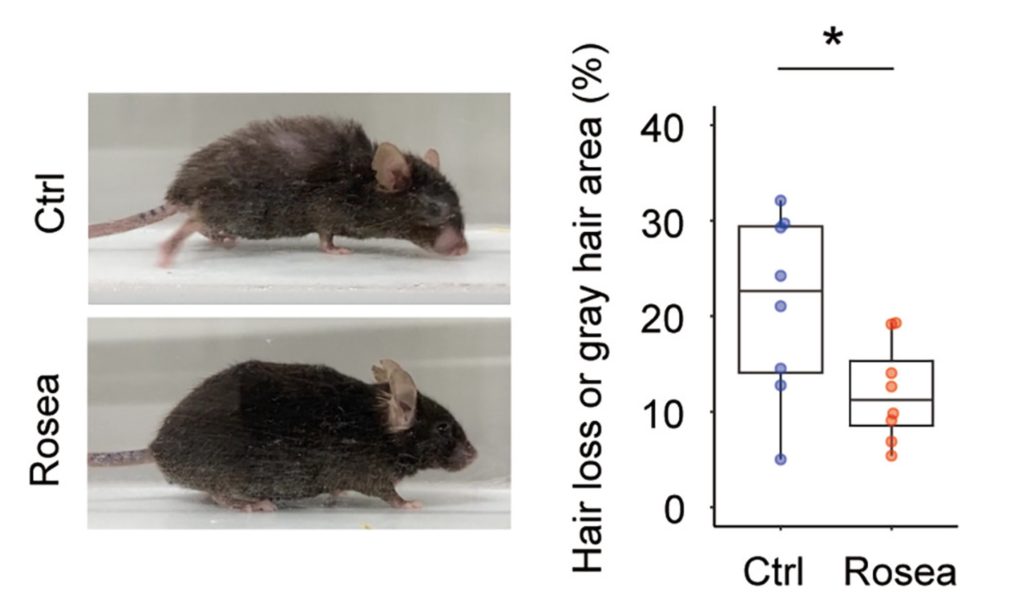
The middle-aged mice were roughly equivalent in age to 44-year-old humans (12 months). To test the effect of Rosea on older mice, the researchers used mice roughly equivalent in age to 58-year-old humans (19 months). In these mice, Rosea reduced hair loss/graying and increased skin thickness, which is linked to increased collagen and elasticity. There were also signs of decreased senescence within the skin tissue.
The researchers also assessed the mice’s sleep-wake cycle, also known as circadian rhythms. Older mice are known to have disrupted circadian rhythms. Namely, they are more active during the day (when they usually sleep) and less active during the night (when they are usually awake), the opposite of humans. The Juntendo researchers found that Rosea countered this disruption, suggesting improved sleep-wake cycle activity.
How Rosea May Eliminate Senescent but not Normal Cells
To explore how Rosea might eliminate senescent cells, the Juntendo researchers examined its major components. Among them, EGCG (epigallocatechin gallate), a compound abundant in green tea, showed senolytic activity. Rosea also contains compounds related to EGCG, including EGC (epigallocatechin). These related compounds can combine to form short chains, which the researchers found to have more potent senolytic activity than EGCG alone.
They then showed that one of these short chains, EGC-EGCG, induced a form of cell death called paraptosis, where structures like mitochondria burst due to calcium (Ca2+) overload. Specifically, they found that senescent cells have higher levels of mitochondrial calcium and that EGC-EGCG elevates these calcium levels. This suggests that Rosea affects only senescent cells because they are more susceptible to paraptosis.
Eliminating Senescent Cells for a Longer Life
Depending on where senescent cells are in the body, they can be particularly harmful. Reducing senescent cells in certain tissues may potentially alleviate the degeneration of those tissues and contribute to reducing the risk of chronic life-shortening diseases like heart disease, Alzheimer’s disease, type 2 diabetes, and obesity.
For instance, senescent muscle stem cells can spread senescence to surrounding stem cells, which reside in specialized microenvironments. Muscle stem cells are needed to regenerate muscle tissue and maintain muscle mass. Moreover, studies have shown that senescent muscle stem cells contribute to a chronic disease called sarcopenia. Sarcopenia, characterized by muscle mass, strength, and quality loss, is associated with a shorter lifespan. Thus, reducing the spread of senescent stem cells could potentially contribute to a longer life by preventing sarcopenia.
However, this and other examples of how senescent cells may contribute to a shorter life have not been confirmed in humans. More research is needed because eliminating senescent cells too broadly, particularly senescent stem cells, could deplete stem cell stores, weaken tissue repair, and potentially speed up degeneration. Senescent cells also have beneficial roles, such as supporting wound healing. For these reasons, the most promising senolytics may be those that target the less essential (senescent) cells while sparing cells that are still needed for tissue maintenance and repair.
Model: Three models of C57BL/6 mice: Obese (4-weeks-old), middle-aged (12-months-old), and older (19-months-old).
Dosage: Rhodiola rosea root extract was mixed into the mice’s drinking water (0.05% weight/volume), which they could consume freely.
 Comments