


Uridine Improves Egg Quality and Fertility During Aging: New Study Shows
Study shows that uridine supplementation improves egg quality, fertilization, embryo development, and fertility in aged mice by protecting eggs from cellular damage.
Highlights
- Uridine supplementation improves egg quality and fertility in aged mice.
- Treatment suppresses ferroptosis, an iron-dependent form of cell death linked to aging.
- Uridine restores mitochondrial function and reduces DNA damage in aging eggs.
Female fertility declines steadily with age, and this decline accelerates after the mid-30s. By age 40, natural fertility has fallen by approximately 50% compared with women in their late 20s, while the risk of miscarriage and chromosomal abnormalities rises substantially. These changes are partly driven by a shrinking ovarian reserve – the number of eggs remaining in the ovaries – as well as declining egg quality, which makes successful fertilization and embryo development less likely.
Although assisted reproductive technologies such as in vitro fertilization (IVF) – where an egg and sperm are joined in a laboratory dish – have improved pregnancy outcomes, IVF success rates also decline sharply with maternal age. This is the case because these treatments cannot repair the age-related damage that gradually accumulates within eggs.
Scientists have increasingly recognized that metabolism plays a central role in reproductive aging. Eggs require enormous amounts of energy to complete maturation, maintain chromosome integrity, and support early embryonic development. As metabolism becomes disrupted with age, these processes begin to fail, leading researchers to investigate whether restoring key metabolites could help preserve fertility.
In a recent study published in Nature Communications, researchers investigated whether restoring levels of uridine, a naturally occurring molecule involved in RNA synthesis and cellular metabolism, could improve reproductive aging. The researchers found that uridine improved egg quality and fertility in aged mice, in part by suppressing ferroptosis, an iron-dependent form of cell death.
Uridine Levels Decline With Age
When researchers compared young and aged mice, uridine emerged as one of the metabolites that consistently declined with age. Levels were significantly lower in both the blood and ovaries of older mice, suggesting that uridine levels decline across the body, including in reproductive tissues. Uridine plays a role in RNA production, energy metabolism, and mitochondrial function. Because these processes are important for healthy eggs, the researchers tested whether replacing the uridine lost with age could improve egg quality and fertility.
Uridine Improves Egg Quality and Fertility
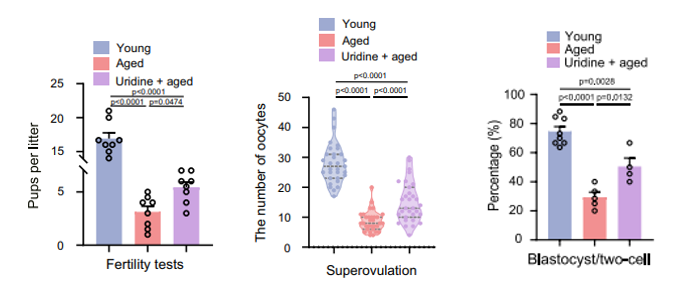
Aged female mice given daily uridine injections for ten days had significantly better reproductive outcomes. Treatment restored uridine levels in the blood and ovaries and increased average litter size by approximately 74% compared with untreated aged mice.
The improvement in fertility was accompanied by healthier eggs. Compared with young animals, aged mice produced fewer mature eggs and had higher rates of egg fragmentation, abnormal chromosome alignment, spindle defects, and aneuploidy – an abnormal number of chromosomes that becomes more common with maternal age. Uridine improved each of these measures, increasing the number of mature eggs while reducing chromosome and spindle abnormalities.
These improvements continued through fertilization and early embryonic development. Uridine increased sperm binding and fertilization rates and increased the proportion of embryos that developed into blastocysts, the stage embryos must reach before implantation. Treatment also restored markers of cytoplasmic maturation, the process that prepares an egg with the proteins, energy stores, and other components needed to support fertilization and early embryo development. Together, the results suggest that restoring uridine helps reverse several aspects of declining egg quality in aged mice rather than improving only a single step in reproduction.
How Uridine Protects Aging Eggs
The researchers traced many of uridine’s benefits to ferroptosis, an iron-dependent form of cell death that was elevated in aging eggs. Ferroptosis occurs when excess iron and oxidative stress damage cell membranes, eventually causing cells to die.
Uridine reduced several signs of this damage. Treated eggs accumulated less iron, produced fewer harmful oxygen-containing molecules, and showed less damage to their cell membranes. Uridine also restored glutathione, one of the cell’s major antioxidant defenses, helping protect eggs from oxidative damage.
Uridine also improved mitochondrial health. Mitochondria generate the energy required for egg maturation, but their function declines with age. Treatment restored mitochondrial organization and membrane potential, a measure of how well mitochondria are functioning, while also reducing DNA damage and early signs of cell death.
When researchers artificially triggered ferroptosis or impaired mitochondrial function, many of uridine’s protective effects disappeared. This suggests that protecting eggs from ferroptosis and mitochondrial damage is a key part of how uridine improves egg quality.
Restoring Uridine May Help Preserve Fertility With Age
Female fertility continues to decline worldwide as more women delay childbearing. In the United States, the average age at first birth has increased by nearly four years over the past five decades, and the World Health Organization estimates that approximately one in six people experience infertility during their reproductive years. Identifying interventions that preserve egg quality before fertility declines has therefore become an increasingly important area of aging research.
The findings suggest that ferroptosis contributes to age-related declines in egg quality and that restoring uridine levels may help counter this process. By reducing oxidative damage and improving mitochondrial function, uridine improved egg maturation, fertilization, embryo development, and overall fertility in aged mice.
Uridine-containing supplements are already commercially available, most commonly as uridine monophosphate (UMP), with some products providing 250 mg per capsule. Human studies have also shown that oral UMP can increase circulating uridine levels. In the current study, researchers gave mice approximately 37.6 mg/kg of uridine daily. This corresponds to a human-equivalent dose of approximately 186.6 mg per day for a 70-kg (165-pound) adult. However, this does not mean that taking 186.6 mg of a commercial uridine supplement would produce the same effects seen in the study. The mice received uridine by injection, while supplements typically contain oral forms such as UMP that differ in absorption and metabolism. Researchers have not established a dose that improves egg quality or fertility in humans.
Although the current study was conducted in mice, previous research has also reported lower uridine levels in eggs collected from older women, suggesting that similar metabolic changes may occur during human reproductive aging. Clinical studies will need to determine whether uridine supplementation can safely improve egg quality or fertility in women and establish an effective dose. The results provide an early basis for exploring uridine as a potential way to target the metabolic changes that contribute to reproductive aging.
Model: Aged female ICR or C57BL/6J mice (48–56 weeks old)
Dosage: Approximately 37.6 mg/kg/day of uridine was administered by intraperitoneal injection for 10 consecutive days. The researchers tested several doses and selected 37.6 mg/kg/day (10 mg/mL; 0.1 mL per mouse) for subsequent experiments because it improved egg maturation without observable toxicity.
 Comments