


Urolithin A Counters Memory Loss from Sleep Deprivation in Aged Mice, New Study Shows
Highlights
- Urolithin A prevents sleep-deprivation-induced brain inflammation in both young and aged mice.
- It also prevents mitochondrial dysfunction in both young and aged sleep-deprived mice.
- Urolithin A prevents structural changes to neurons and memory loss in mice that have been sleep-deprived for one night.
What if the negative consequences of sleep deprivation could be countered with just a pill? A recent study published in Molecular Neurobiology suggests this could be the case, at least when it comes to brain inflammation, mitochondrial dysfunction, and memory loss.
Urolithin A Prevents Sleep-Deprivation-Induced Brain Inflammation
Many of our personal experiences are formed into memories with the help of brain structures called hippocampi. However, sleep deprivation can impair the hippocampi, making it harder to form lasting memories of new experiences. For these reasons, in this study, researchers from China examined the hippocampi of sleep-deprived young and aged mice.
Like the rest of the brain, hippocampi consist of neurons, as well as support cells like microglia. Microglia, the brain’s resident immune cells, constantly monitor and surveil the brain for invading pathogens or tissue damage. When they encounter such pathogens or damage, they become “activated” and attempt repairs. However, if they stay activated for too long, they can begin causing damage.
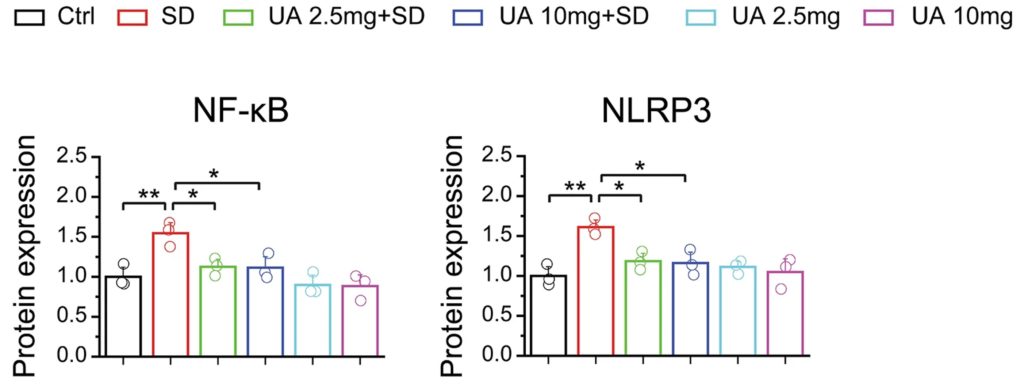
The researchers found that sleep deprivation increased the proportion of activated microglia in the hippocampi of young and aged mice. In their activated form, microglia can release inflammatory signaling molecules that spread inflammation to surrounding cells. In this study, sleep deprivation increased the protein levels of NF-κB and NLRP3, which are key drivers of inflammation. Remarkably, urolithin A largely prevented microglial activation and the increase in inflammatory signaling.
Activated microglia can also stimulate the reactive form of brain cells called astrocytes. Astrocytes normally help regulate synapses, the junctions through which neurons communicate. However, some forms of reactive astrocytes promote synapse dysfunction or loss, potentially impairing memory. The researchers found that sleep deprivation increased the proportion of reactive astrocytes, which was largely prevented by urolithin A treatment.
Together, these findings suggest that urolithin A can prevent the brain inflammation induced by sleep deprivation in young and aged mice.
Urolithin A Prevents Sleep-Deprivation-Induced Mitochondrial Dysfunction
Our cells—including neurons, microglia, and astrocytes—contain mitochondria, the primary structures responsible for producing cellular energy. Within each cell, mitochondria form a dynamic network that continually divides and reconnects. Fission splits mitochondria, which can help separate damaged portions from the network. Damaged mitochondria can then be selectively dismantled and recycled through mitophagy. In contrast, fusion joins mitochondria together, allowing them to share contents and support one another’s function.
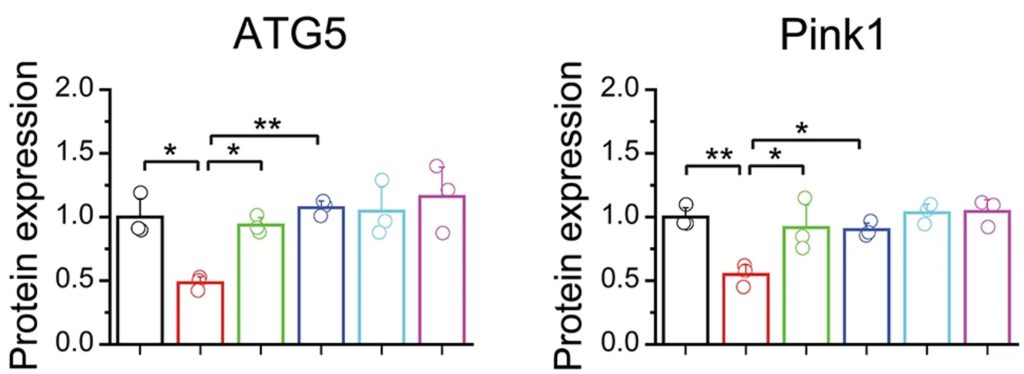
The researchers found that sleep deprivation reduced markers of mitochondrial fission in the hippocampi of both young and aged mice. Markers of fusion fell only in aged mice. Sleep deprivation also impaired autophagy—the broader cellular process that breaks down and recycles cellular structures—and mitophagy in the hippocampi. Urolithin A, injected for seven days before the 24-hour sleep-deprivation period, largely prevented these sleep-deprivation-associated changes in fission, fusion, autophagy, and mitophagy
Urolithin A Prevents Sleep-Deprivation-Induced Memory Loss and Neuronal Damage
Inflammation and mitochondrial dysfunction underlie several age-related conditions, including cognitive impairment, Alzheimer’s disease, and Parkinson’s disease. If these defects are persistently sustained, such as with chronic sleep deprivation, they could potentially accelerate the development of such brain aging disorders.
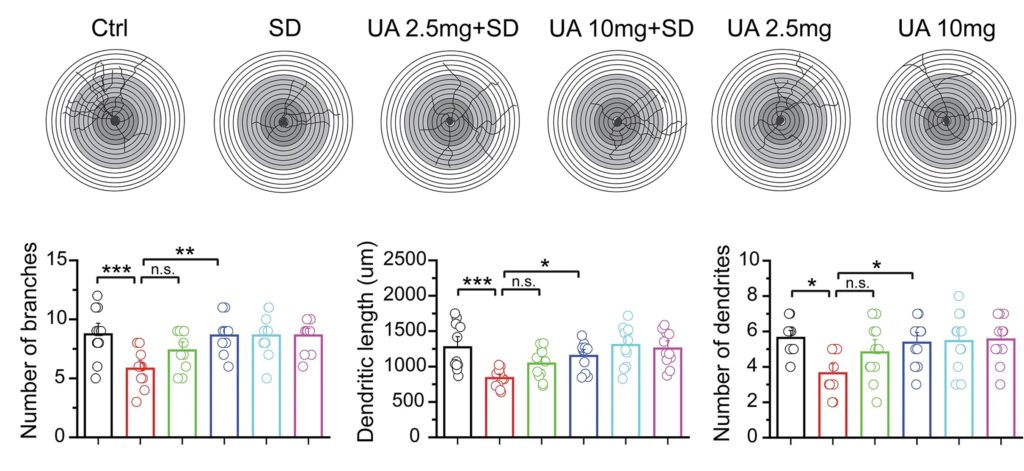
The researchers found that sleep deprivation impaired the performance of young and aged mice on memory tests. Additionally, in aged mice, they found that sleep deprivation reduced the branching of neurons. The length and number of branches, called dendrites, were also diminished by sleep deprivation. Dendrites, along with axons, are remodeled to form the synaptic connections that help store memories. Urolithin A pretreatment at 10 mg/kg/day, but not 2.5 mg/kg per day, protected against the sleep-deprivation-associated changes in neuronal structure. Furthermore, both doses preserved memory-test performance in young and aged mice.
Is Taking Urolithin A Enough to Counter Sleep-Deprivation-Induced Brain Aging?
In a previous mouse study, urolithin A reduced fatigue-like measures, improved grip strength, and lowered inflammatory markers in sleep-deprived mice. Whether these findings, or the results of the current study, translate to sleep-deprived people remains unknown.
Although adequate sleep remains the most effective remedy for sleep loss, consistently getting enough sleep can be difficult amid work, caregiving, and other demands. Enliven is a multi-ingredient formulation designed to support biological pathways that may be disrupted by insufficient sleep, potentially including pathways influenced by urolithin A. Still, Enliven itself has not been evaluated in human trials for sleep deprivation, so its ability to offset sleep-loss–related effects has not been established.u
Model: C57BL/J mice placed on a treadmill that turns on for 4 seconds every 12 seconds for 24 hours
Dosage: 2.5 mg/kg/day or 10 mg/kg/day injections of urolithin A
 Comments