


Urolithin A May Counter Aspects of Heart Failure, New Study Shows
Urolithin A, a molecule usually produced by gut bacteria, enhances engineered human cardiac tissue while also counteracting heart failure in mice.
Highlights
- The purported anti-aging molecules quercetin, fisetin, and urolithin A increase blood vessel relaxation.
- Urolithin A supplementation counters heart failure in mice.
- Treating engineered human heart tissue with urolithin A reduces contraction time, suggesting improved cardiac function.
A damaged, weak, or rigid heart can lead to heart failure, which is associated with early death. However, treatments for this age-related condition, in which the heart fails to efficiently pump blood, remain limited.
To search for novel treatments that enhance heart muscle relaxation, researchers from King’s College London tested several purported anti-aging compounds, including quercetin, fisetin, and urolithin A. In a new study published in Science, they showed that urolithin A counters heart failure in mice. Moreover, they found that urolithin A not only enhances the relaxation but also the contraction of cardiac tissue engineered from human cells.
Polyphenols Quercetin, Fisetin, and Urolithin A Relax Blood Vessels
With each heartbeat, cardiac muscle contracts to pump out blood, then relaxes to refill. If the heart cannot fully relax, it becomes rigid, limiting the refill volume—in turn, reducing the amount of blood that can be pumped out. The relaxation phase depends largely on the activation of an enzyme called PKGIα. Thus, the King’s College researchers tested whether quercetin, fisetin, or urolithin A, which are plant-based molecules called polyphenols, activate PKGIα.
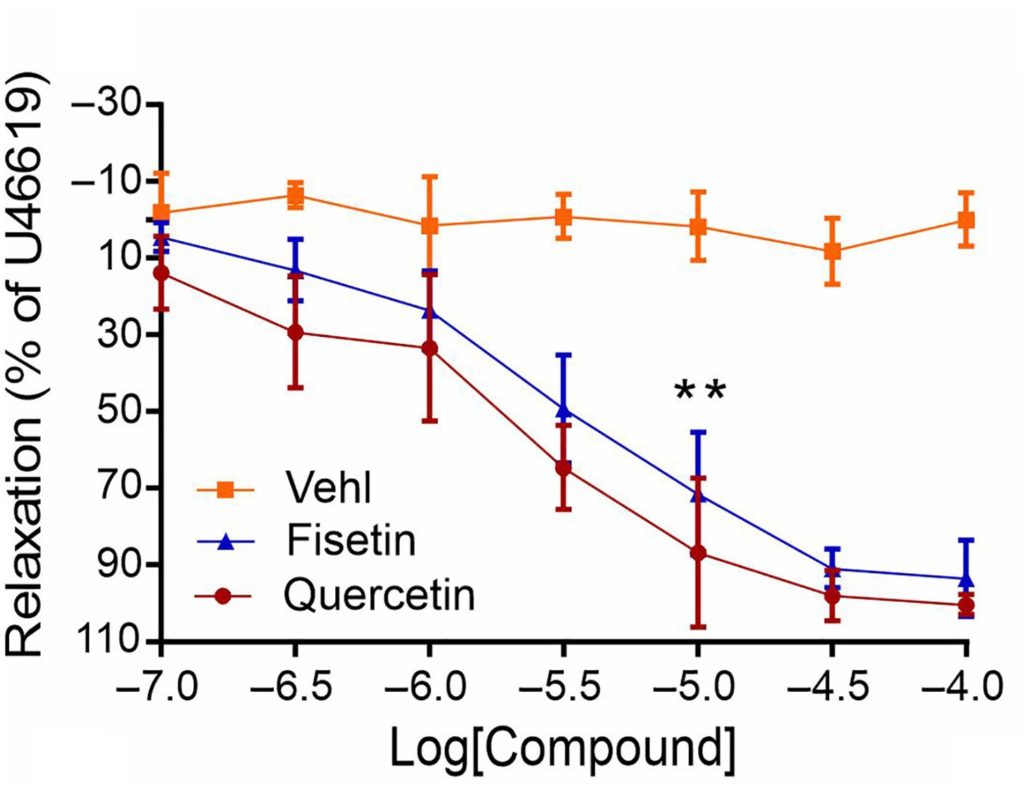
The researchers found that both quercetin and fisetin dilated blood vessels to similar levels, suggesting they activate PKGIα to promote blood vessel relaxation. Urolithin A was also shown to dilate blood vessels to the same degree as quercetin, suggesting it too activates PKGIα. Indeed, the researchers went on to find that urolithin A directly activates PKGIα.
Urolithin A Counters Heart Failure in Mice
Given its role in promoting relaxation via PKGIα activation, the researchers tested urolithin A in a mouse model for heart failure. To induce heart failure, the researchers surgically removed a kidney from each mouse and exposed them to a steroid drug to induce severely high blood pressure. The mice were also fed a high-fat diet to promote metabolic dysregulation, inflammation, and heart stiffness. These heart failure mice were then fed urolithin A (50 mg/kg per day) for 7 days.
To assess heart function, the King’s College researchers used echocardiography, a non-invasive imaging method that uses sound waves to visualize the heart and measure blood flow.
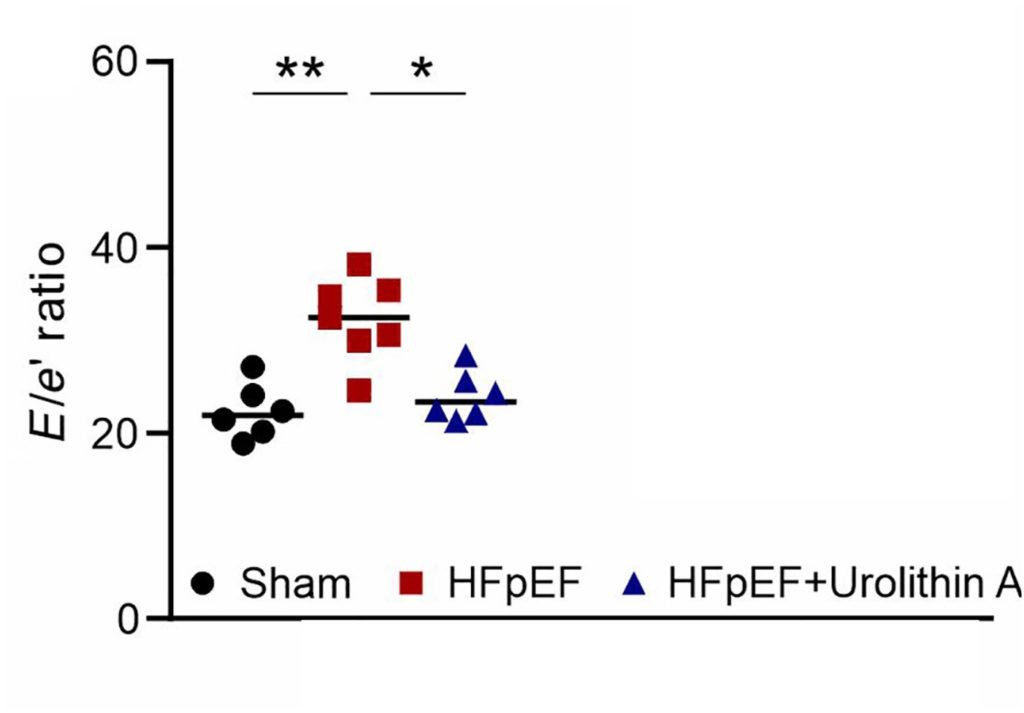
They showed that the heart failure mice exhibited several aspects of cardiac dysfunction, including a high E/e′ ratio. This ratio reflects the filling and relaxation of the heart:
- E is the peak velocity of blood flow into the left ventricle, the bottom-left chamber of the heart.
- e′ serves as an indicator of left-ventricular relaxation.
Urolithin A was shown to counter much of the cardiac dysfunction exhibited by the heart failure model, including the E/e′ ratio.
Urolithin A also improved the structure of the heart. For example, it reduced fibrosis, the buildup of stiff scar tissue that occurs when the body’s normal healing response becomes excessive or dysregulated. Along with these improvements, the urolithin A-treated heart failure mice were able to run longer on a treadmill. These findings suggest that urolithin A can counter the ill consequences of heart failure in an experimental mouse model.
Urolithin A Enhances Human Heart Cell Contraction and Relaxation
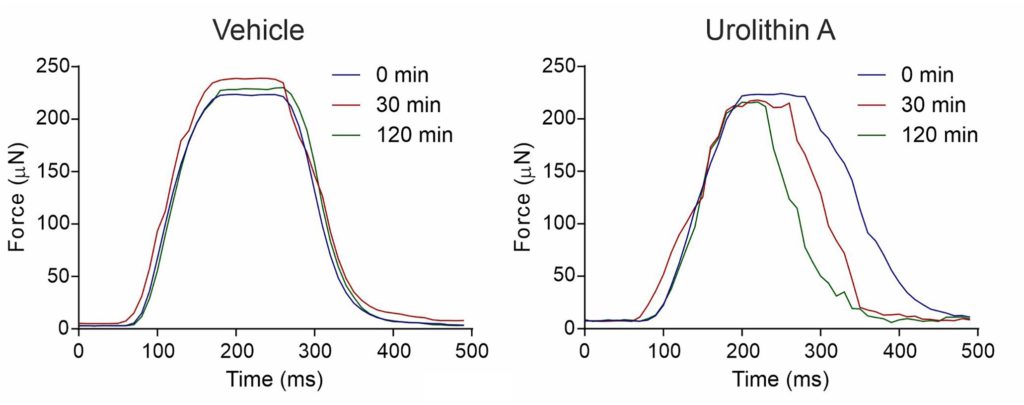
To further evaluate urolithin A’s potential in treating heart failure, the researchers chemically transformed stem cells from a single donor into heart muscle cells—cardiomyocytes. The human-derived cardiomyocytes, grown in a mold, could contract and produce force, but urolithin A had no significant effect on the maximal force generated. Still, the time it took for the cardiomyocytes to contract and relax was decreased by urolithin A treatment. These findings suggest that urolithin A can improve the efficiency of human cardiomyocyte function.
Can Urolithin A Counteract Regular Heart Aging in Healthy Individuals?
Studies suggest that aging can impair the function of mitochondria in cardiomyocytes, the muscle cells that enable the heart to pump blood. In healthy people, left-ventricular relaxation also begins to slow in early middle age and declines further in later life. A study found progressively slower measures of left-ventricular relaxation with age, with the greatest impairment in adults aged 65 and older.
Urolithin A may address both of these age-related changes. It promotes mitophagy, the cellular quality-control process that removes damaged mitochondria and helps maintain a healthier mitochondrial network. In the King’s College study, urolithin A improved cardiomyocyte relaxation. Together, these findings suggest that urolithin A could help counter the mitochondrial dysfunction and impaired cardiac relaxation associated with aging—though this possibility still needs to be confirmed in people.
 Comments