


AI Reveals How NMN and Mitochondrial Cleanup May Shape Brain Aging in New Study
Nicotinamide mononucleotide (NMN)- and mitochondria-related genes are altered with age and in neurodegenerative diseases, and AI has identified five of them that can be targeted with drugs.
Highlights
- Brain genes related to NMN/nicotinamide adenine dinucleotide (NAD+) and mitochondrial cleanup are altered with age and in four neurodegenerative diseases.
- AI narrowed down the top five of these genes that drugs could target: ULK1, LAMP2, MFN1, OPA1, and ATP6V0E.
- In various models, these genes were shown to play a role in aging and neurodegeneration, suggesting that AI is a useful tool.
In a new study published in Alzheimer’s & Dementia, researchers in Norway used Insilico Medicine’s AI technology to identify drug targets for alleviating brain aging and neurodegeneration. They analyzed “more than 100 nicotinamide mononucleotide (NAD+)/mitophagy–related genes across different ages and neurodegenerative diseases in 12 brain regions and blood samples.” While the research does not show that NMN treats neurodegeneration, it provides a rationale for why maintaining NAD+ may matter for mitochondrial and brain health.
NMN (NAD+) Fuels Mitochondrial Cleanup
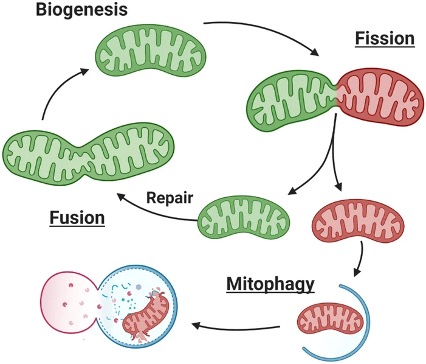
NMN is converted into NAD+, which is a molecule essential for mitophagy—the recycling and elimination of damaged or unnecessary mitochondria. Mitophagy ensures that mitochondria function efficiently, acting as a mitochondrial quality control and cleanup system. In return, healthy mitochondria produce sufficient levels of cellular energy, ATP, which the brain uses to cope with neurodegenerative stress. With age, lingering damaged mitochondria generate excess levels of reactive oxygen species (ROS), causing damage to cells, leading to brain aging and neurodegenerative diseases.
NAD+ and Mitophagy Genes Change with Age in Brain
To better understand the relationship between NAD+/mitophagy and aging, the Norwegian researchers chose 36 NAD+-related genes and 67 mitophagy-related genes. They then measured how these genes changed with age in 12 brain regions. They found that 6 genes increased while 20 decreased.
Brain regions associated with decreased NAD+/mitophagy genes included:
- The amygdala, which detects threats and processes emotions, like fear.
- The hippocampus, which is primarily involved in consolidating memories.
- The hypothalamus, which is like the control center of the brain that keeps the body internally balanced.
The regions associated with increased NAD+/mitophagy genes included:
- The frontal cortex, which handles functions like planning, problem-solving, self-control, voluntary movement, and language.
- The cerebellum, which coordinates fine-tuned voluntary movement and maintains balance and posture.
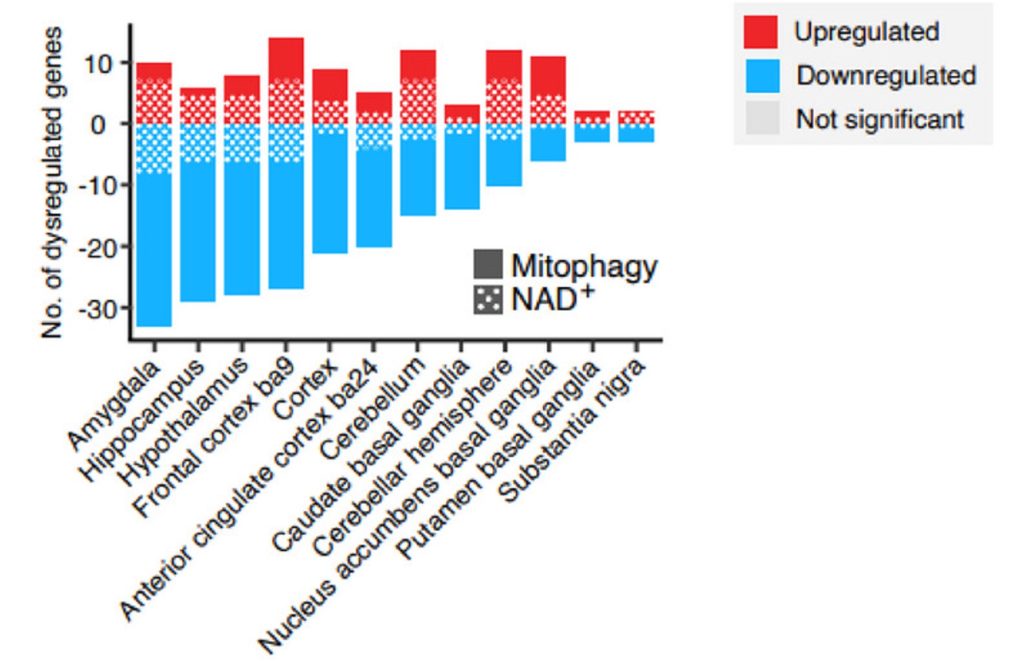
The researchers also measured how these genes changed in four neurodegenerative diseases: Alzheimer’s disease (AD), Huntington’s disease (HD), Parkinson’s disease (PD), and Amyotrophic lateral sclerosis (ALS). LAMP2 stood out as the only gene to be elevated with age but reduced in all four neurodegenerative diseases. LAMP2 plays a key role in destroying broken mitochondria. The hippocampus again had many genes that were decreased. However, with the neurodegenerative diseases, the “fusiform gyrus displayed a remarkable peak in the number of upregulated genes.” The fusiform gyrus handles high-level visual processing, such as facial recognition.
The 5 Target Genes Identified
Based on their findings, the researchers chose to focus on AD to find drug targets with Insilico Medicine’s PandaOmics AI platform. Two genes, ULK1 and LAMP2, performed the best, followed by MFN1, OPA1, and ATP6V0E1. Together, these genes point to a broader mitochondrial quality-control network:
ULK1
Helps initiate autophagy, the general process of recycling and eliminating damaged or unnecessary cellular components, such as misfolded proteins. Mitophagy is the mitochondrial-specific form of autophagy.
LAMP2
Supports lysosomes, the final degradative stage of autophagy/mitophagy. Lysosomes are membrane-bound sacs filled with acid and digestive enzymes that break down mitochondria and other unwanted or harmful materials, like pathogens and unfolded proteins.
OPA1 and MFN1
Work together to help regulate mitochondrial fusion. When mitochondria become damaged, the damaged segments are isolated for removal (fission). The remaining healthy segments are then rejoined to the other healthy mitochondria (fusion).
ATP6V0E1
Is involved with an enzyme called V-ATPase (vacuolar-type H+-ATPase), which helps acidify the inside of cellular structures like lysosomes. V-ATPase uses ATP to transfer protons (hydrogen atoms without electrons) into lysosomes to lower the pH and generate an acidic environment.
Together, these findings point to the importance of brain cells sensing damaged mitochondria, separating the malfunctioning mitochondria from the healthy ones, and destroying the unhealthy mitochondria.
Real World Validation of AI’s Findings
To test whether the AI-selected targets could influence aging and neurodegenerative biology in a living organism, the researchers studied tiny worms called C. elegans. Experiments involving the worm equivalents of AI-identified genes (e.g., unc-51 is the worm equivalent to human ULK1, as these critical genes are conserved across species) supported the idea that mitochondrial quality control can affect aging-related, neurodegenerative stress, and longevity.
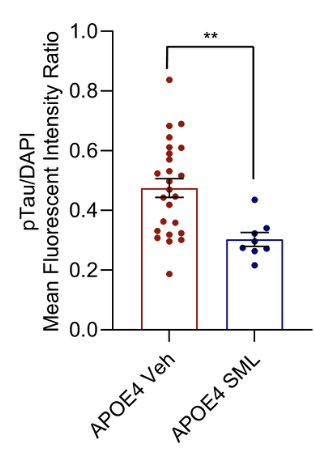
The researchers also used a human cell model engineered to accumulate tau, a protein that can form harmful clumps in AD and interfere with the function and survival of neurons. Increasing MFN1 or LAMP2 reduced tau accumulation, whereas increasing OPA1 did not. In neuronal cells, stimulating mitophagy also made tau less likely to accumulate. Together, these findings suggest that supporting mitochondrial quality-control pathways could help reduce neurodegenerative stress and cellular features associated with brain aging.
“Conclusively, we demonstrate that the NAD+–mitophagy axis is dysregulated in brain aging and more severely in neurodegenerative disease (AD, PD, HD, and ALS). Beyond ULK1 (unc-51), we identified LAMP2 (lmp-1), OPA1 (eat-3), MFN1 (fzo-1), and ATPV0E1 (vha-17) as candidate regulators of AD and demonstrated that their neuronal loss partially affected aging, neuronal dysfunction and Tau pathology in C. elegans and human cellular models. Further studies in higher organisms are warranted for detailed mechanistic insight and to assess their therapeutic potential,” said the authors of the study.
Taking NMN to Stimulate Mitophagy
Studies have shown that NMN and other NAD+ boosters may support the induction of mitophagy. Studies like these were mostly conducted in cells within a dish, C. elegans, and mice. However, researchers have not yet shown that NMN induces mitophagy in the human brain or that it prevents or treats neurodegenerative disease.
 Comments