


Mice Emit Light When Alive but Not Dead: What Does This Mean for Aging?
Scientists speculate that the ultra-weak light emitted from all living organisms, detected by highly sensitive cameras, could one day be used to diagnose, or maybe even treat, chronic diseases of aging.
Highlights
- That cells could somehow communicate via light has been researched since the 1920s, and that ultra-weak light is emitted from living organisms has been confirmed.
- Two underlying biological drivers of aging are closely linked to the production of light by living organisms.
- Red-light therapy, clinically confirmed to affect the nervous system, may prove to be a viable therapy targeting mitochondria, which absorb red and infrared light to produce more cellular energy.
Let’s not talk about auras. Scientists like Dr. Nirosha Murugan, a biophysicist, attribute misconceptions about biological light to a “lack of awareness.”
“Most people simply do not know that biological light is a real area of study with methods, mechanisms, and biomedical relevance,” she said to Nature magazine.
Another physicist, Dr. Maurizio Benfatto, told Nature that “narrow-minded” scientists outright dismiss biological light, specifically biophotons—ultra-weak particles of light emitted from living cells. And Dr. Nick Lane, a biochemist and writer, said: “It’s one of those fields that feels like it is on the edge of respectability.”
While there are always naysayers when it comes to new ideas that alter established beliefs, biophotons could one day be used to diagnose or maybe even treat ailments of aging, such as neurodegenerative disorders, cancer, and heart disease. At least this is what some scientists believe, according to a recent article published in Nature.
When “Pseudoscience” Becomes Reality?
In 2025, Dr. Daniel Oblak and his team at Calgary University in Canada published a paper showing that mice emit more biophotons when they are alive compared to when they are dead. These findings generated a buzz, but this was not the first time scientists provided evidence of biophotons. Before they were called biophotons, their existence was realized in the 1920s, when biologist Dr. Alexander Gurwitsch found that onion roots could induce cell division in neighboring roots unless light travel between them was blocked. However, the study’s design was full of technical problems, and so this phenomenon was placed under the radar.
It was not until the 1950s that technology had progressed far enough to accurately measure single photons. Devices called photomultiplier tubes can convert incoming photons into electrons and then amplify those electrons into a large electrical signal that we can see. Once this valuable measuring tool was invented, scientists confirmed that a wide range of organisms, from bacteria to plants to mammals, emit biophotons. Still, the pseudoscience accusations continue, as some scientists associate biophotons with treatments poorly backed by scientific evidence, such as homeopathy.
Biophotons and Oxidative Stress, a Hallmark of Aging
In the more recent decades, scientists who study the biology of aging—geroscientists—have identified several underlying processes thought to drive the aging process, known as the hallmarks of aging. One of these hallmarks relates to reactive oxygen species (ROS)—highly reactive molecules transiently produced, primarily by mitochondria.
Oxidative Stress and Biophotons
Studies show that, as we age, our mitochondria accumulate damage, rendering them dysfunctional and primed to generate excess levels of ROS. At the same time, our natural antioxidant defenses tend to diminish, and our cells become overwhelmed with ROS. When left unchecked, ROS react with DNA, cell membranes, and other critical cell components, damaging them and promoting cell dysfunction and cell death.
Oxidative stress, a hallmark of aging, is the term used to describe damage caused to cells by excess levels. When ROS react with other molecules, they release biophotons. Each type of ROS may emit a different wavelength (color) of light when it reacts with other molecules. For example, some ROS emit red, and some emit blue-green. While low levels of ROS are inevitably produced during normal metabolism, which sustains life, their role in oxidative stress could help to identify disease states associated with aging, such as cancer, Alzheimer’s, and type 2 diabetes.
Oxidative Stress, Injury, and Light Emissions
Oxidative stress from aging is similar to oxidative stress from injury. By injuring a leaf, Dr. Oblak and his team observed the oxidative stress response in real time.
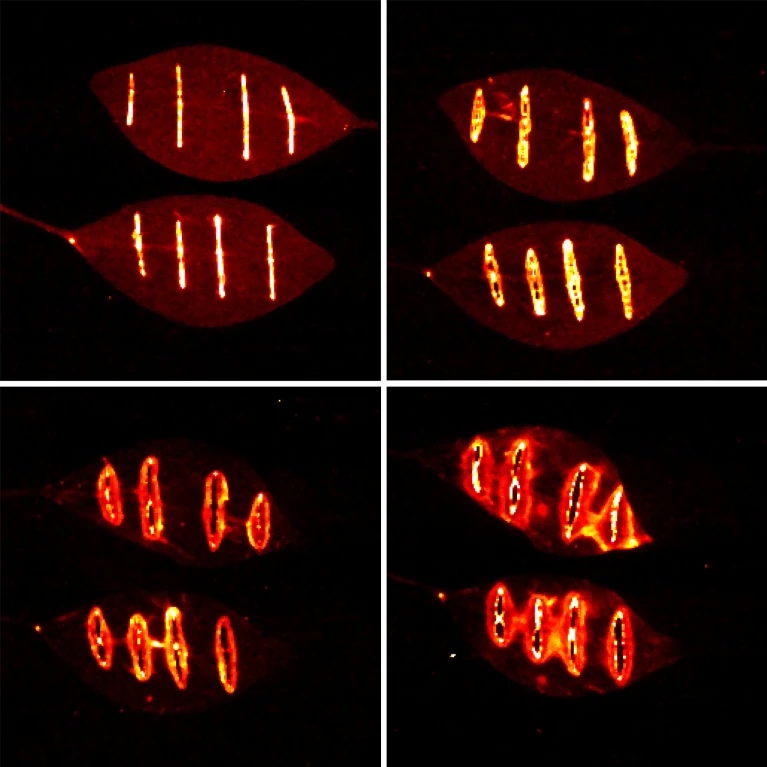
“I’m fascinated by the fact that just by watching the light, one can potentially assess the liveliness, the metabolic activity, the degree of oxidative stress,” said Dr. Michal Cifra, a biophysicist who researches bioelectrodynamics, to Nature.
Biophotons and Mitochondrial Dysfunction, another Hallmark of Aging
Some say mitochondrial dysfunction is the most important hallmark of aging. Without mitochondria, we would not be alive, and neither would any other multicellular organism. They are the main source of cellular energy, which they produce by utilizing oxygen from air and electrons from food. Within mitochondria, these electrons sometimes go rogue and react with oxygen, generating ROS. Dysfunctional mitochondria tend to generate more ROS than normal.
In a 2024 study from the University of Westminster in London, researchers found that dysfunctional mitochondria could trigger dysfunction in neighboring healthy mitochondria, without any physical contact. This effect was reduced if the light travel between the mitochondria was blocked. Moreover, the effects were stronger when dysfunctional mitochondria from cancer cells were placed near healthy mitochondria. These findings suggest that mitochondrial dysfunction can somehow spread via biophotons.
Potential Light Therapies Targeting Mitochondria
Key enzymes within mitochondria absorb a range of light, largely corresponding to the red and infrared wavelength range. Moreover, a study has shown that near-infrared light increases the amount of cellular energy, ATP, produced by mitochondria in mice. This suggests that red light therapy could be used to target mitochondrial dysfunction, an important hallmark of aging.
Since mitochondria appear to spread dysfunction via light, could they also spread mitochondrial health? Can red light therapy boost mitochondrial health? If so, red light therapy could counteract the mitochondrial dysfunction associated with aging, leading to a reduction in ROS and oxidative stress. Such an effect could rejuvenate cells and the tissues they inhabit, promoting more youthful organs and tissues.
Nervous System Aging
According to an article in Nature, unpublished data from the lab of neuroscientist Dr. John Mitrofanis suggest that light “makes an older brain look more like a younger brain.” The brain demands a disproportionate amount of cellular energy compared to the rest of the body, and brain aging is associated with reduced energy utilization, leading to neuron dysfunction and neuron death. Thus, it is possible that increasing the production of ATP in the brain with red-light therapy could counteract brain aging. However, getting light across the skull poses a challenge.
Nevertheless, clinical studies have shown that red-light therapy can improve conditions like peripheral neuropathy, retinal degeneration, and neurological disorders. These improvements to the energetically demanding nervous system by red light suggest that biophotons could counteract the aging process at the cellular level by mitigating mitochondrial dysfunction and oxidative stress. However, scientists still do not fully understand the biology of aging, and biophoton research has just reemerged, so we wait.
 Comments